
352-001 · Question #692
Refer to the exhibit. A new high availability DB server cluster is installed in the network. These two servers require high bandwidth and low latency Layer 2 connectivity for database replication…
The correct answer is C. Add secondary links to REP segments 1 and 2. Adding secondary links to existing REP segments integrates the DB cluster into the current ring topology, providing high-bandwidth Layer 2 paths with sub-second failover for database replication.
Question
Refer to the exhibit. A new high availability DB server cluster is installed in the network. These two servers require high bandwidth and low latency Layer 2 connectivity for database replication. Which solution supports these requirements?
Exhibit
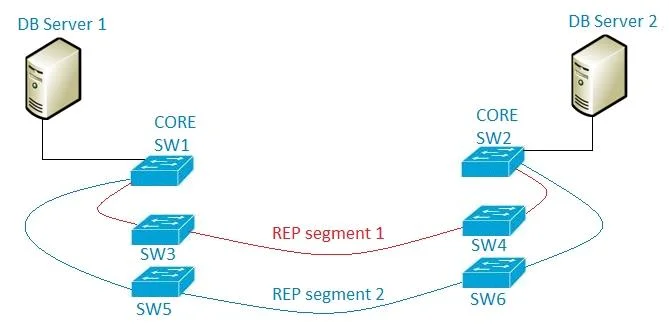
Options
- AAdd two new links between SW1 and SW2 configured as LACP trunk with STP
- BAdd two new links between SW1 and SW2 configured as REP segments 1 and 2, respectively
- CAdd secondary links to REP segments 1 and 2
- DAdd two new links between SW1 and SW2 configured as REP segment 3
How the community answered
(68 responses)- A12% (8)
- B6% (4)
- C79% (54)
- D3% (2)
Why each option
Adding secondary links to existing REP segments integrates the DB cluster into the current ring topology, providing high-bandwidth Layer 2 paths with sub-second failover for database replication.
LACP trunk aggregates bandwidth effectively but the inclusion of STP means redundant ports will be blocked or face reconvergence delays of up to 30-50 seconds with classic STP, which is incompatible with the low-latency requirement for DB replication.
Configuring the new links as separate REP segments 1 and 2 conflicts with existing segment IDs already assigned in the ring, causing a configuration error and failing to properly integrate the DB servers into the current REP ring topology.
REP secondary links add an alternate port within an existing REP segment, allowing the DB servers to leverage the ring topology's fast failover (under 50ms) without the blocking delays inherent to STP. This approach maintains the existing ring architecture, provides dedicated high-bandwidth Layer 2 paths, and meets the low-latency requirement for synchronous database replication.
Adding a new REP segment 3 between SW1 and SW2 creates an isolated segment outside the established ring topology, which does not leverage the ring's redundancy mechanism and does not provide an optimal Layer 2 path for the DB cluster.
Concept tested: REP secondary links for Layer 2 high availability
Source: https://www.cisco.com/c/en/us/td/docs/switches/lan/catalyst3750e_3560e/software/release/12-2_55_se/configuration/guide/3750escg/swrep.html
Topics
Community Discussion
No community discussion yet for this question.