
352-001 · Question #528
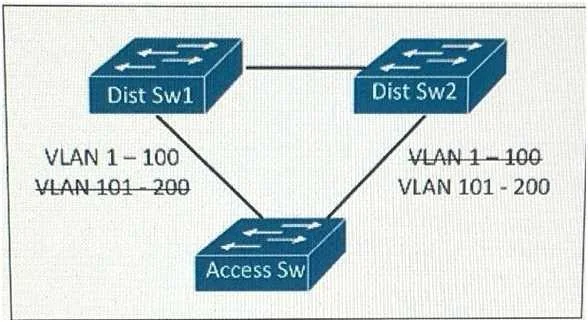
Refer to the exhibit. This layer 2 network is expected to add 150 VLANS over the next year, In addition to the existing 50 VLANs within the network which STP types will support this design…
The correct answer is C. MST. MST (Multiple Spanning Tree) groups hundreds of VLANs into a small number of instances, drastically reducing CPU overhead compared to per-VLAN protocols while enabling load balancing across instances.
Question
Refer to the exhibit. This layer 2 network is expected to add 150 VLANS over the next year, In addition to the existing 50 VLANs within the network which STP types will support this design requirement the least amount of CPU resource and achieving load balancing?
Exhibit
Options
- APVST+
- BCST
- CMST
- DRSTP
How the community answered
(32 responses)- A3% (1)
- B6% (2)
- C88% (28)
- D3% (1)
Why each option
MST (Multiple Spanning Tree) groups hundreds of VLANs into a small number of instances, drastically reducing CPU overhead compared to per-VLAN protocols while enabling load balancing across instances.
PVST+ creates one independent STP instance per VLAN, meaning 200 VLANs require 200 separate STP processes, causing excessive CPU consumption at scale.
CST runs a single STP instance for all VLANs across the entire network, which means there is only one root bridge and no mechanism for per-VLAN or per-group load balancing.
MST allows all 200 VLANs to be mapped into a configurable number of instances (e.g., 2-3), so the CPU only runs STP calculations for those instances rather than for each VLAN individually. This keeps CPU utilization low regardless of VLAN count. Different VLAN groups can be mapped to different instances with different root bridges, achieving load balancing across uplinks.
RSTP is a single-instance protocol like CST and provides faster convergence but offers no load balancing capability and no per-VLAN or per-group traffic distribution.
Concept tested: MST VLAN scalability and load balancing
Source: https://www.cisco.com/c/en/us/td/docs/switches/lan/catalyst4500/12-2/25ew/configuration/guide/conf/stpmstp.html
Topics
Community Discussion
No community discussion yet for this question.