
352-001 · Question #519
Refer to the Exhibit. In which three Layers should you use nonstop Forwarding to reduce service impact in case of failure? (Choose three)
The correct answer is A. Enterprise Edge B. Enterprise Core C. Service provider Edge. NSF should be deployed at routed boundary and transit layers - Enterprise Core, Enterprise Edge, and Service Provider Edge - where a control-plane failure would otherwise drop routing adjacencies and disrupt traffic forwarding.
Question
Refer to the Exhibit. In which three Layers should you use nonstop Forwarding to reduce service impact in case of failure? (Choose three)
Exhibit
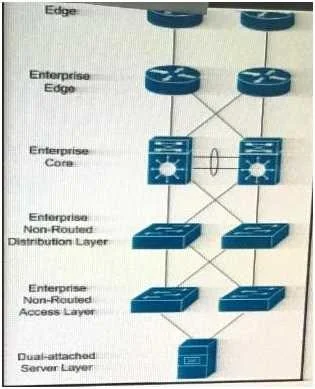
Options
- AEnterprise Edge
- BEnterprise Core
- CService provider Edge
- DDual-attached sever Layer
- EEnterprise Non-Routed Access Layer
- FEnterprise Non-Routed Distribution Layer.
How the community answered
(32 responses)- A78% (25)
- D13% (4)
- E3% (1)
- F6% (2)
Why each option
NSF should be deployed at routed boundary and transit layers - Enterprise Core, Enterprise Edge, and Service Provider Edge - where a control-plane failure would otherwise drop routing adjacencies and disrupt traffic forwarding.
The Enterprise Edge is a routed boundary connecting internal networks to service providers, so NSF with SSO ensures that a supervisor or RP failover does not tear down BGP sessions or disrupt routing adjacencies with upstream providers.
The Enterprise Core carries all transit traffic between distribution blocks and is the most critical routed layer, where NSF prevents packet loss and routing protocol reconvergence delays during a supervisor failover event.
The Service Provider Edge terminates BGP and other routing protocols with the enterprise, making NSF essential to maintain routing adjacencies and continuous forwarding during hardware or supervisor failures at that boundary.
The dual-attached server layer is a switched access layer without complex routing adjacencies that NSF would protect - servers attach via Layer 2 and do not maintain routing protocol sessions that could benefit from nonstop forwarding.
A non-routed access layer operates entirely at Layer 2 and runs no routing protocols, so NSF - which preserves routing protocol state during RP failover - provides no benefit and is not applicable in this layer.
A non-routed distribution layer similarly operates at Layer 2 without routing protocol adjacencies, making NSF inapplicable since there is no routing state to preserve during a failover event.
Concept tested: NSF deployment placement in enterprise network hierarchy layers
Source: https://www.cisco.com/c/en/us/td/docs/ios-xml/ios/ha/configuration/xe-16/ha-xe-16-book/ha-nonstop-fwdg.html
Topics
Community Discussion
No community discussion yet for this question.