
352-001 · Question #513
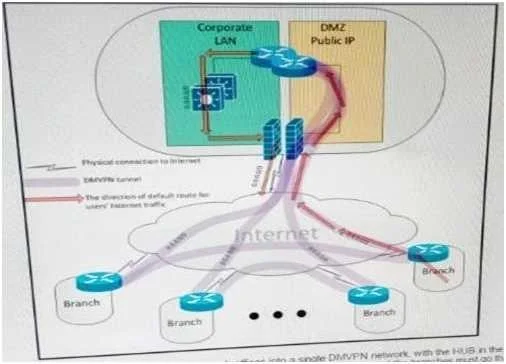
Refer to the exhibit. A customer interconnected hundreds of branch offices into a single DMVPN network, with the HUB in the main data center. Due to security policies, the customer requires that the…
The correct answer is A. Place the WAN interface in a front-door VRF, leaving the tunnel interface in the default routing B. Protect the WAN interface by an inbound ACL that permits only IPsec-related traffic. Securing DMVPN branch WAN interfaces at scale requires Front-Door VRF (FVRF) to isolate the WAN routing table combined with an inbound ACL permitting only IPsec traffic.
Question
Refer to the exhibit. A customer interconnected hundreds of branch offices into a single DMVPN network, with the HUB in the main data center. Due to security policies, the customer requires that the default route for all Internet traffic from the users at the branches must go through the tunnel and the only connections that are allowed to and from the branch router over the local internet circuit are the DMVPN tunnels. Which two combined actions must you take on the branch router to address these security requirements and keep the solution scalable? (Choose two)
Exhibit
Options
- APlace the WAN interface in a front-door VRF, leaving the tunnel interface in the default routing
- BProtect the WAN interface by an inbound ACL that permits only IPsec-related traffic
- CImplement a zone-based firewall that allows only IPsec-related traffic from zone UNTRUSTED to
- DAdd a host route for the public IP address of each remote branch and HUB routers that points
- EUse a floating default route with the preferred path over the tunnel and a backup path over the
How the community answered
(43 responses)- A49% (21)
- C28% (12)
- D9% (4)
- E14% (6)
Why each option
Securing DMVPN branch WAN interfaces at scale requires Front-Door VRF (FVRF) to isolate the WAN routing table combined with an inbound ACL permitting only IPsec traffic.
Front-Door VRF places the physical WAN interface into a separate VRF so that all user traffic routes through the DMVPN tunnel in the default VRF, while the WAN VRF holds only the routes needed to reach DMVPN peers - this is scalable because the same template applies to every branch without per-branch static route management.
An inbound ACL on the WAN interface that explicitly permits only IKE (UDP 500), NAT-T (UDP 4500), and ESP (protocol 50) traffic satisfies the security policy requirement by dropping all non-IPsec traffic at the edge, and this ACL template can be applied identically to hundreds of branches without modification.
Zone-based firewall can enforce the same IPsec-only policy but requires significantly more complex per-router configuration compared to a simple inbound ACL, making it far less scalable across hundreds of branch routers.
Adding a static host route for each remote branch and HUB router is explicitly not scalable when the network contains hundreds of branches, as it creates an unmanageable number of static entries on every branch.
A floating default route controls routing path preference between the tunnel and WAN backup, but does not enforce the security requirement of blocking non-IPsec traffic from traversing the local internet circuit.
Concept tested: DMVPN Front-Door VRF and WAN inbound ACL security
Source: https://www.cisco.com/c/en/us/td/docs/ios-xml/ios/sec_conn_dmvpn/configuration/xe-16/sec-conn-dmvpn-xe-16-book.html
Topics
Community Discussion
No community discussion yet for this question.