
352-001 · Question #468
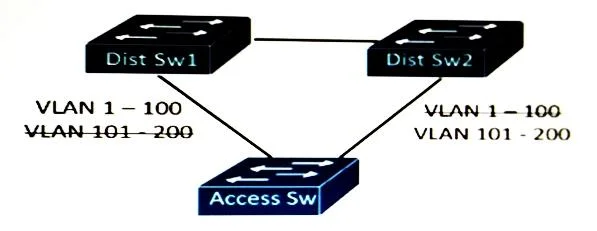
Refer to the exhibit. This Layer 2 network is expected to add 150 VLANs over the next year, in addition to the existing 50 VLANs within the network. Which STP type will support this design…
The correct answer is B. MST. MST (802.1s) groups multiple VLANs into a small number of spanning tree instances, making it optimal for large VLAN counts with minimal CPU overhead and built-in load balancing.
Question
Refer to the exhibit. This Layer 2 network is expected to add 150 VLANs over the next year, in addition to the existing 50 VLANs within the network. Which STP type will support this design requirement using the least amount of CPU resources and achieving load-balancing?
Exhibit
Options
- ARSTP
- BMST
- CPVST+
- DCST
How the community answered
(29 responses)- A7% (2)
- B83% (24)
- C3% (1)
- D7% (2)
Why each option
MST (802.1s) groups multiple VLANs into a small number of spanning tree instances, making it optimal for large VLAN counts with minimal CPU overhead and built-in load balancing.
RSTP (802.1w) is a single-instance protocol covering all VLANs with no per-VLAN or per-group load balancing capability.
MST maps many VLANs to a limited number of spanning tree instances (commonly 16 or fewer), so adding 150 more VLANs does not proportionally increase CPU load. Unlike PVST+, it does not spawn a separate STP process per VLAN. Load balancing is achieved by mapping different VLAN groups to different MST instances, each with a different root bridge.
PVST+ runs one independent spanning tree instance per VLAN, so 200 VLANs would require 200 separate STP processes, consuming significantly more CPU resources.
CST (Common Spanning Tree, 802.1D) uses a single instance for all VLANs and provides no load balancing across different VLAN traffic paths.
Concept tested: MST scalability and load balancing across VLANs
Source: https://www.cisco.com/c/en/us/support/docs/lan-switching/spanning-tree-protocol/24062-146.html
Topics
Community Discussion
No community discussion yet for this question.