
352-001 · Question #442
Refer to the exhibit. The two Ethernet switches are in close proximity to each other. Assuming that the IGP timers have already been tuned for fast convergence, which additional change provides for…
The correct answer is B. Use point-to-point links between the routers instead of connecting through the Ethernet switches. Connecting routers through Ethernet switches creates a multi-access broadcast segment, requiring OSPF DR/BDR election which adds convergence delay - eliminating the switches with direct point-to-point links removes that overhead.
Question
Refer to the exhibit. The two Ethernet switches are in close proximity to each other. Assuming that the IGP timers have already been tuned for fast convergence, which additional change provides for the fastest network convergence time?
Exhibit
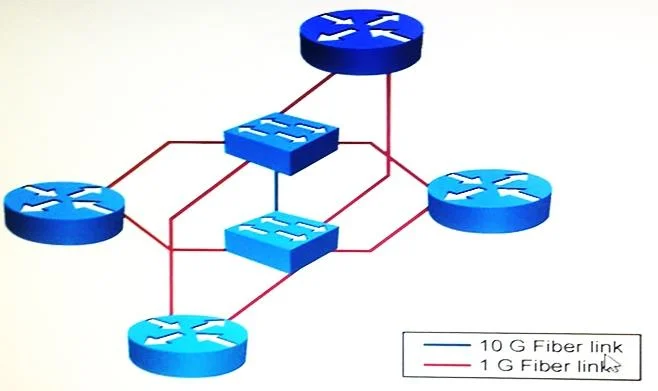
Options
- AChange all links from fiber to copper.
- BUse point-to-point links between the routers instead of connecting through the Ethernet switches.
- CRemove one of the Ethernet switches and connect all routers to only one Ethernet switch.
- DChange all links between switches and routers to 10 Gb/s.
How the community answered
(34 responses)- A6% (2)
- B71% (24)
- C9% (3)
- D15% (5)
Why each option
Connecting routers through Ethernet switches creates a multi-access broadcast segment, requiring OSPF DR/BDR election which adds convergence delay - eliminating the switches with direct point-to-point links removes that overhead.
Changing from fiber to copper does not improve convergence time and would typically degrade performance due to lower bandwidth and higher latency.
On a broadcast multi-access segment (such as an Ethernet switch), OSPF must elect a Designated Router and Backup Designated Router before full adjacencies form, introducing wait states and election delays. Point-to-point links between routers bypass DR/BDR election entirely, allowing two-way adjacency to reach Full state immediately. With IGP timers already tuned, removing this DR/BDR overhead is the single most impactful remaining change to reduce convergence time.
Reducing to a single switch still leaves a broadcast multi-access segment, so OSPF DR/BDR election overhead remains and convergence time is not significantly improved.
Upgrading link speed to 10 Gb/s reduces transmission delay marginally but does not eliminate the OSPF DR/BDR election delay, which is the dominant convergence bottleneck on a broadcast segment.
Concept tested: OSPF convergence on point-to-point vs broadcast links
Source: https://www.cisco.com/c/en/us/support/docs/ip/open-shortest-path-first-ospf/13692-21.html
Topics
Community Discussion
No community discussion yet for this question.