
352-001 · Question #387
Refer to the exhibit. You are designing an MPLS network with Layer 3 VPNs, where the traffic path must be the same in both directions inside the MPLS network to ensure that symmetric routing occurs…
The correct answer is B. The MPLE TE tunnels should be set up in both directions so that the same path is used. E. There should not be any equal cost paths for the IGP and the BGP inside the MPLS backbone. To achieve symmetric routing in an MPLS Layer 3 VPN, TE tunnels must be explicitly configured in both directions and equal-cost paths for both IGP and BGP must be eliminated to prevent load-balancing that would cause asymmetric flows.
Question
Refer to the exhibit. You are designing an MPLS network with Layer 3 VPNs, where the traffic path must be the same in both directions inside the MPLS network to ensure that symmetric routing occurs. The sites are connected to two PE routers. Which two design considerations will allow you to achieve this symmetric routing? (Choose two.)
Exhibit
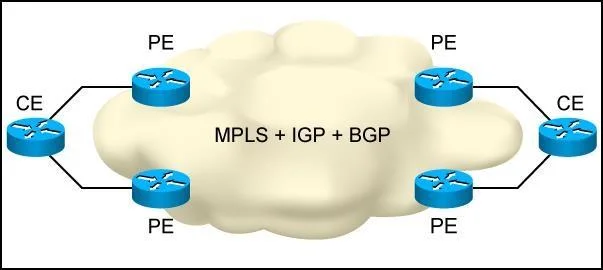
Options
- AWhen MPLS TE is used, the bidirectional TE tunnel automatically provides symmetric routing.
- BThe MPLE TE tunnels should be set up in both directions so that the same path is used.
- CThere should not be any equal cost paths for IGP inside the MPLS backbone, the IGP routing
- DThere should not be any equal cost paths for BGP inside the MPLS backbone, the BGP routing
- EThere should not be any equal cost paths for the IGP and the BGP inside the MPLS backbone,
How the community answered
(16 responses)- A19% (3)
- B63% (10)
- C13% (2)
- D6% (1)
Why each option
To achieve symmetric routing in an MPLS Layer 3 VPN, TE tunnels must be explicitly configured in both directions and equal-cost paths for both IGP and BGP must be eliminated to prevent load-balancing that would cause asymmetric flows.
MPLS TE tunnels are strictly unidirectional and there is no automatic bidirectional mechanism - a reverse tunnel must always be manually configured to match the forward path.
MPLS TE tunnels are unidirectional by nature; to force the same physical path in both directions, a separate TE tunnel must be provisioned for each direction, explicitly constraining the forward and reverse traffic to traverse the same links.
Eliminating IGP ECMP alone is insufficient because BGP can still perform load-balancing over multiple equal-cost BGP paths, allowing the reverse direction to take a different path than the forward direction.
Eliminating BGP ECMP alone is insufficient because IGP ECMP inside the backbone can still split traffic across different links, causing asymmetric routing in the opposite direction.
Equal-cost multipath (ECMP) for either IGP or BGP inside the backbone can cause the forward and reverse flows to take different paths independently; eliminating ECMP for both protocols together is the only way to guarantee a single deterministic path in both directions.
Concept tested: MPLS TE symmetric routing design considerations
Source: https://www.cisco.com/c/en/us/td/docs/ios-xml/ios/mp_te/configuration/xe-16/mp-te-xe-16-book/mpte-overview.html
Topics
Community Discussion
No community discussion yet for this question.