
352-001 · Question #324
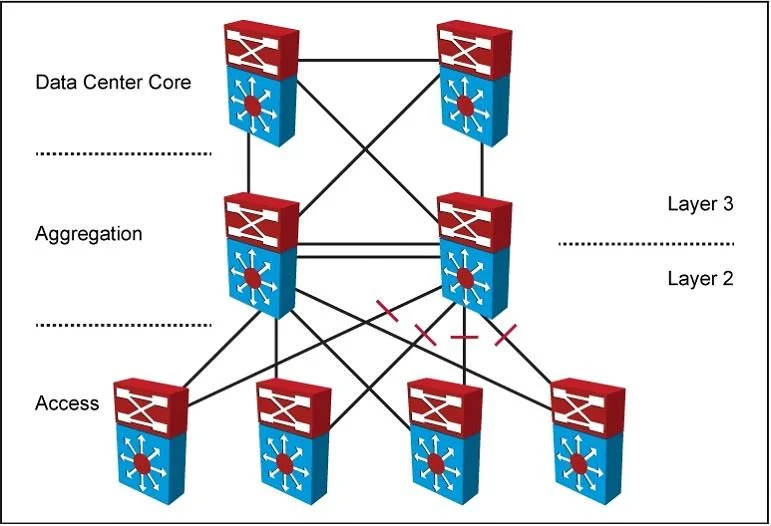
Refer to the exhibit. Your company designed a network to allow server VLANs to span all access switches in a data center. In the design, Layer 3 VLAN interfaces and HSRP are configured on the…
The correct answer is A. BPDU guard on access ports E. Root guard on the aggregation switch downlinks toward access switches. BPDU guard on access ports and root guard on aggregation downlinks prevent unauthorized switches and root bridge election instability, improving STP stability.
Question
Refer to the exhibit. Your company designed a network to allow server VLANs to span all access switches in a data center. In the design, Layer 3 VLAN interfaces and HSRP are configured on the aggregation switches. Which two features will improve STP stability within the network design? (Choose two.)
Exhibit
Options
- ABPDU guard on access ports
- BEdge port on access ports
- CRoot guard on access ports
- DBPDU guard on the aggregation switch downlinks toward access switches
- ERoot guard on the aggregation switch downlinks toward access switches
- FAccess switch pairs are explicitly determined to be root and backup root bridges
How the community answered
(62 responses)- A74% (46)
- B3% (2)
- C6% (4)
- D2% (1)
- F15% (9)
Why each option
BPDU guard on access ports and root guard on aggregation downlinks prevent unauthorized switches and root bridge election instability, improving STP stability.
BPDU guard on access ports immediately err-disables any port that receives a BPDU, preventing unauthorized switches from injecting topology change notifications and disrupting the STP domain.
Edge port (PortFast) only bypasses listening and learning states for faster end-device connectivity; it provides no protection against unauthorized BPDUs or STP topology instability.
Root guard on access ports facing end devices is ineffective because end devices do not send BPDUs; root guard protection must be applied on the aggregation downlinks where access switches connect.
BPDU guard on aggregation downlinks toward access switches would err-disable those ports upon receiving legitimate BPDUs from access switches, causing a network outage rather than improving stability.
Root guard on aggregation switch downlinks toward access switches blocks any port that receives a superior BPDU, ensuring access switches can never usurp the root bridge role and destabilize the intended topology.
Manually configuring root and backup root priority is a planning best practice but is not a proactive enforcement feature - it can still be overridden by a rogue switch with a lower bridge ID without root guard.
Concept tested: STP stability features in data center access-aggregation design
Source: https://www.cisco.com/c/en/us/td/docs/switches/lan/catalyst6500/ios/12-2SX/configuration/guide/book/stpopt.html
Topics
Community Discussion
No community discussion yet for this question.