
352-001 · Question #322
Refer to the exhibit. Which two options are two characteristics of the single-tier headend architecture for DMVPN designs? (Choose two.)
The correct answer is A. The mGRE and crypto functions are on the same router. C. It is used in dual-cloud topologies for spoke-to-spoke connectivity. Single-tier DMVPN headend combines mGRE and IPsec crypto on one router and is used in dual-cloud topologies to enable spoke-to-spoke connectivity.
Question
Refer to the exhibit. Which two options are two characteristics of the single-tier headend architecture for DMVPN designs? (Choose two.)
Exhibit
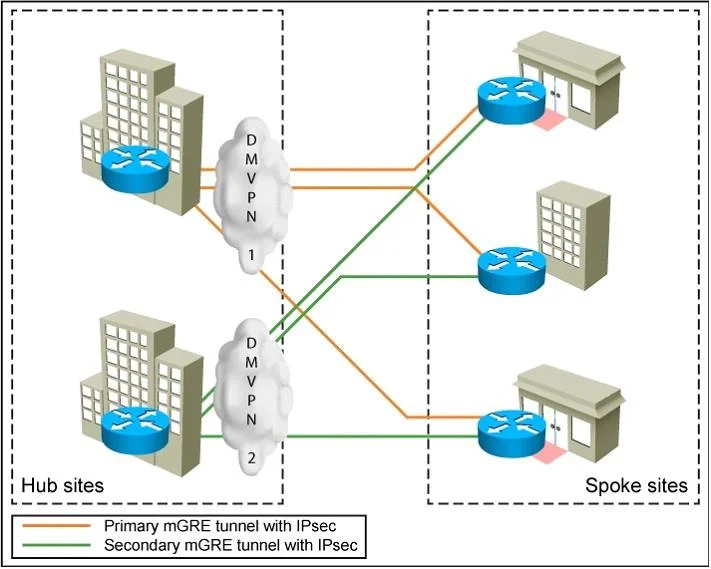
Options
- AThe mGRE and crypto functions are on the same router.
- BEach DMVPN cloud has two different headend routers for high availability purposes.
- CIt is used in dual-cloud topologies for spoke-to-spoke connectivity.
- DIt only supports hub-and-spoke connectivity.
- ESpokes cannot be used as RP in multicast deployments.
How the community answered
(40 responses)- A73% (29)
- B10% (4)
- D13% (5)
- E5% (2)
Why each option
Single-tier DMVPN headend combines mGRE and IPsec crypto on one router and is used in dual-cloud topologies to enable spoke-to-spoke connectivity.
In a single-tier headend, the same physical router handles both mGRE tunnel termination and IPsec crypto processing, unlike dual-tier designs that offload crypto to a separate device.
Having two different headend routers per DMVPN cloud describes a dual-hub or redundant headend design, which is a characteristic of multi-tier architecture, not single-tier.
Single-tier headend designs are deployed in dual-cloud topologies where each spoke connects to two separate DMVPN clouds, providing redundancy and enabling spoke-to-spoke communication across clouds via NHRP.
DMVPN inherently supports spoke-to-spoke connectivity via NHRP dynamic resolution regardless of headend tier; single-tier does not restrict the design to hub-and-spoke only.
Spokes can be configured as Rendezvous Points in DMVPN multicast deployments; this is not an architectural restriction specific to single-tier headend designs.
Concept tested: DMVPN single-tier headend architecture characteristics
Source: https://www.cisco.com/c/en/us/support/docs/security-vpn/ipsec-negotiation-ike-protocols/41940-dmvpn.html
Topics
Community Discussion
No community discussion yet for this question.