
352-001 · Question #316
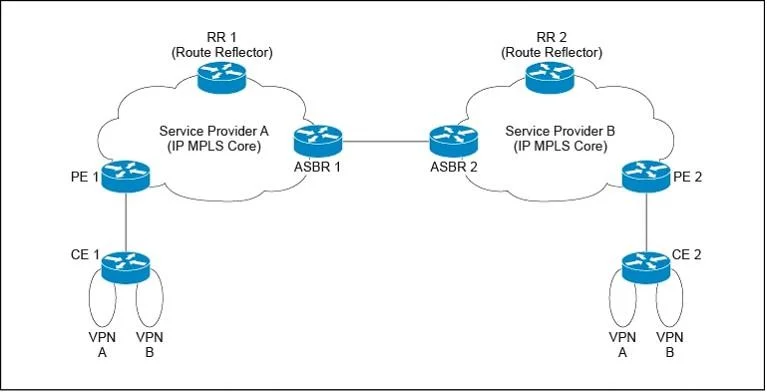
Refer to the exhibit. Service Provider A and Service Provider B have agreed to a strategic interconnect relationship that will allow them access into each other's geographies by using an inter-AS…
The correct answer is A. RR 1 and RR 2 peer using multihop eBGP VPNv4 to exchange prefixes. C. An LSP is formed between ASBR 1 and ASBR 2 using eBGP IPv4. Inter-AS MPLS VPN Option C uses multihop eBGP VPNv4 between route reflectors to exchange customer prefixes, while ASBRs use eBGP labeled IPv4 (RFC 3107) to stitch LSPs across the AS boundary.
Question
Refer to the exhibit. Service Provider A and Service Provider B have agreed to a strategic interconnect relationship that will allow them access into each other's geographies by using an inter-AS eBGP VPNv4 multihop between route reflectors. Which two options will accomplish this scenario? (Choose two.)
Exhibit
Options
- ARR 1 and RR 2 peer using multihop eBGP VPNv4 to exchange prefixes.
- BASBR 1 and ASBR 2 act as inline route reflectors that set themselves as the next-hop.
- CAn LSP is formed between ASBR 1 and ASBR 2 using eBGP IPv4.
- DAn LSP is formed between ASBR 1 and ASBR 2 using eBGP VPNv4.
- ERR 1 and RR 2 peer using multihop eBGP IPv4 to exchange prefixes.
How the community answered
(18 responses)- A56% (10)
- B28% (5)
- D11% (2)
- E6% (1)
Why each option
Inter-AS MPLS VPN Option C uses multihop eBGP VPNv4 between route reflectors to exchange customer prefixes, while ASBRs use eBGP labeled IPv4 (RFC 3107) to stitch LSPs across the AS boundary.
In Option C, route reflectors in each AS establish a direct multihop eBGP VPNv4 peering session to distribute customer VPN routes across the AS boundary, eliminating the need for ASBRs to maintain VPNv4 routing tables. This design scales well because only the RRs require VPNv4 capability and the session is multihop since the RRs are not directly adjacent to each other.
ASBRs acting as inline route reflectors that set themselves as next-hop describes Option B behavior, where ASBRs re-advertise VPNv4 routes - in Option C the ASBRs only exchange labeled IPv4 routes and do not handle VPNv4.
ASBRs exchange labeled IPv4 routes using eBGP IPv4 labeled unicast (RFC 3107) to stitch the LSP across the inter-AS link, enabling end-to-end label-switched forwarding for VPN packets without exposing VPNv4 at the ASBR level. The labels negotiated via this eBGP IPv4 session allow each ASBR to perform a label swap at the AS boundary, completing the end-to-end LSP required for VPN traffic.
ASBRs in Option C use eBGP IPv4 labeled unicast (not VPNv4) to build the inter-AS LSP - VPNv4 routing information is carried only between the RRs, not at the ASBR level.
RRs must exchange VPNv4 (not plain IPv4) to carry customer route distinguishers, VPN labels, and extended communities - plain IPv4 eBGP between RRs would strip the VPN attributes needed for customer prefix separation.
Concept tested: Inter-AS MPLS VPN Option C multihop eBGP VPNv4 and labeled IPv4
Source: https://www.cisco.com/c/en/us/td/docs/ios-xml/ios/mp_l3_vpns/configuration/xe-16/mp-l3-vpns-xe-16-book/mp-inter-as-mpls-vpns.html
Topics
Community Discussion
No community discussion yet for this question.