
352-001 · Question #271
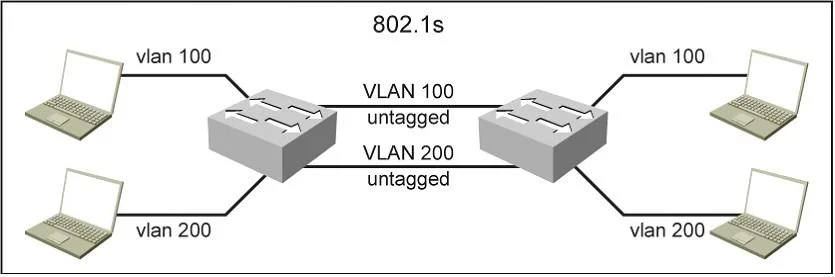
Refer to the exhibit. You are designing a network using the Multiple Spanning Tree Protocol for loop avoidance. VLAN trunking is not allowed due to security requirements. Which option describes how…
The correct answer is C. Assign VLAN 100 to instance 1 and VLAN 200 to instance 2. When VLAN trunking is prohibited and untagged interfaces are used, MST instance mapping must place each VLAN in a separate instance so distinct logical topologies can provide redundancy across the untagged links.
Question
Refer to the exhibit. You are designing a network using the Multiple Spanning Tree Protocol for loop avoidance. VLAN trunking is not allowed due to security requirements. Which option describes how you can design this Layer 2 network while using untagged interfaces between both switches?
Exhibit
Options
- AAssign VLAN 100 and VLAN 200 to the IST instance.
- BAssign VLAN 100 and VLAN 200 to instance 1.
- CAssign VLAN 100 to instance 1 and VLAN 200 to instance 2.
- DAssign VLAN 100 to the IST instance and VLAN 200 to instance 1.
How the community answered
(66 responses)- A26% (17)
- B12% (8)
- C58% (38)
- D5% (3)
Why each option
When VLAN trunking is prohibited and untagged interfaces are used, MST instance mapping must place each VLAN in a separate instance so distinct logical topologies can provide redundancy across the untagged links.
Assigning both VLANs to the IST (Internal Spanning Tree) instance places them in the same topology, eliminating per-VLAN load balancing and defeating the purpose of MST instance separation.
Placing both VLANs in instance 1 provides a single shared topology with no ability to use a second instance for a redundant or load-balanced path.
Assigning VLAN 100 to MST instance 1 and VLAN 200 to MST instance 2 allows each instance to maintain an independent spanning-tree topology over the untagged physical links. This enables load balancing and path redundancy without requiring 802.1Q tagging, since each instance can independently block or forward on different ports.
Using the IST instance for production VLAN 100 is not recommended because the IST is reserved for MST internal communications and carries all VLANs not explicitly mapped to a named instance, which undermines deterministic design.
Concept tested: MST instance VLAN mapping with untagged interfaces
Source: https://www.cisco.com/c/en/us/td/docs/switches/lan/catalyst3750/software/release/12-2_55_se/configuration/guide/scg3750/swmstp.html
Topics
Community Discussion
No community discussion yet for this question.