
352-001 · Question #164
Refer to the exhibit. You are designing a spanning-tree network for a small campus. Which two of these options would result in a trouble-free spanning-tree network design? (Choose two.)
The correct answer is A. Convert all ports to trunk ports, prune off the VLANs that you do not require, and minimize the B. Introduce Layer 3 VLANs (SVIs) and prune off the VLANs that you do not require. Pruning unused VLANs from trunk ports and introducing Layer 3 routing via SVIs reduce STP complexity and limit the blast radius of topology changes in a campus network.
Question
Refer to the exhibit. You are designing a spanning-tree network for a small campus. Which two of these options would result in a trouble-free spanning-tree network design? (Choose two.)
Exhibit
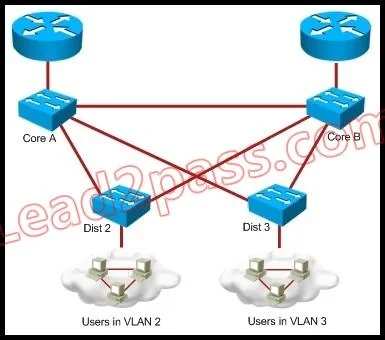
Options
- AConvert all ports to trunk ports, prune off the VLANs that you do not require, and minimize the
- BIntroduce Layer 3 VLANs (SVIs) and prune off the VLANs that you do not require.
- CConvert all the ports to trunk and enable BackboneFast.
- DConvert all the ports to trunk and enable UplinkFast between all the links.
How the community answered
(42 responses)- A71% (30)
- C19% (8)
- D10% (4)
Why each option
Pruning unused VLANs from trunk ports and introducing Layer 3 routing via SVIs reduce STP complexity and limit the blast radius of topology changes in a campus network.
Converting ports to trunks while actively pruning unused VLANs limits the number of active STP instances per link, reducing the scope of topology change notifications and the risk of widespread forwarding disruptions across the campus.
Introducing Layer 3 SVIs segments the network at Layer 3 and shrinks each STP domain to a single distribution block rather than allowing it to span the entire campus, which isolates topology change impacts and reduces convergence time.
BackboneFast accelerates convergence specifically for indirect link failures by allowing a switch to skip the Max Age timer, but it does not address fundamental STP design problems like excessive VLAN propagation or oversized spanning-tree domains.
UplinkFast is intended only for access-layer switches with redundant uplinks to speed convergence when a direct uplink fails; enabling it between all links including distribution and core tiers can cause unintended MAC address flooding and STP instability.
Concept tested: Spanning Tree design with VLAN pruning and Layer 3 segmentation
Source: https://www.cisco.com/c/en/us/support/docs/lan-switching/spanning-tree-protocol/19120-122.html
Topics
Community Discussion
No community discussion yet for this question.