
352-001 · Question #107
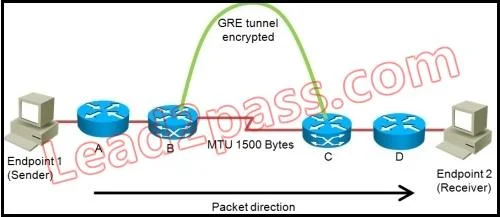
Refer to the exhibit. You are planning the design of an encrypted WAN. IP packets will be transferred over encrypted GRE tunnels between routers B and C. The packet size is limited to a maximum of…
The correct answer is A. When router B fragments packets after the encryption, router C must reassemble these fragmented D. When router B fragments packets before the encryption, endpoint 2 must reassemble these fragmented F. When router A fragments packets, endpoint 2 must reassemble these fragmented packets. In an encrypted GRE tunnel design with a 1500-byte WAN MTU, where and when a packet is fragmented determines which device is responsible for reassembly.
Question
Refer to the exhibit. You are planning the design of an encrypted WAN. IP packets will be transferred over encrypted GRE tunnels between routers B and C. The packet size is limited to a maximum of 1500 bytes inside the WAN between routers B and C. If endpoint 1 tries to send 1500-byte IP packets to endpoint 2, in what three ways will the network design handle the fragmentation in three different possible network configurations? (Choose three.)
Exhibit
Options
- AWhen router B fragments packets after the encryption, router C must reassemble these fragmented
- BWhen router B fragments packets before the encryption, router C must reassemble these fragmented
- CWhen router B fragments packets after the encryption, the endpoint 2 must reassemble these
- DWhen router B fragments packets before the encryption, endpoint 2 must reassemble these fragmented
- EWhen router A fragments packets, router C must reassemble these fragmented packets.
- FWhen router A fragments packets, endpoint 2 must reassemble these fragmented packets.
How the community answered
(47 responses)- A62% (29)
- B6% (3)
- C19% (9)
- E13% (6)
Why each option
In an encrypted GRE tunnel design with a 1500-byte WAN MTU, where and when a packet is fragmented determines which device is responsible for reassembly.
When router B fragments the packet after encryption, the outer IP layer splits the already-encrypted GRE packet into multiple IP fragments. Router C, as the far-end tunnel endpoint, must reassemble those outer IP fragments before it can decrypt the GRE payload.
When router B fragments before encryption, the fragments are encrypted and sent as separate tunnel packets; router C decrypts and passes them to endpoint 2, so endpoint 2 - not router C - performs IP reassembly.
When router B fragments after encryption, the outer IP fragments are reassembled by router C before decryption; endpoint 2 does not receive or reassemble fragmented packets in this scenario.
When router B fragments the inner packet before encryption, each fragment is individually encrypted and forwarded as a separate tunnel packet. Router C decrypts and forwards each fragment onward, but since the original IP datagram was split at the inner layer, endpoint 2 is responsible for final IP reassembly.
When router A fragments packets, the fragments traverse the GRE tunnel independently and router C only decapsulates them; IP-layer reassembly is performed by endpoint 2, not router C.
When router A fragments packets before they reach the tunnel, each fragment is independently encapsulated in GRE and forwarded through the tunnel. Router C decapsulates the fragments and forwards them toward endpoint 2, which performs the final IP reassembly.
Concept tested: GRE tunnel fragmentation and reassembly with IPsec encryption
Source: https://www.cisco.com/c/en/us/support/docs/ip/generic-routing-encapsulation-gre/25885-pmtud-ipfrag.html
Topics
Community Discussion
No community discussion yet for this question.