
352-001 · Question #10
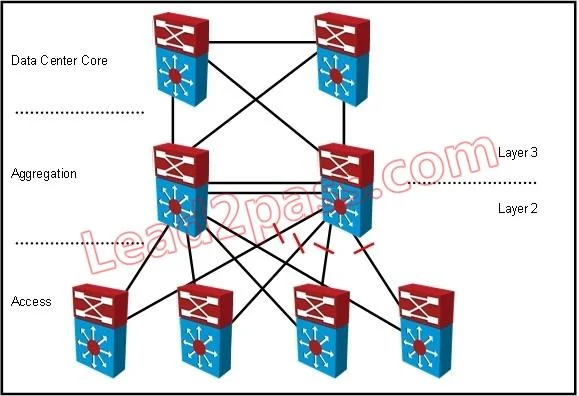
Refer to the exhibit. Your company designed a network to allow server VLANs in a data center to span all access switches. In the design, Layer 3 VLAN interfaces and HSRP are configured on the…
The correct answer is B. Use PortFast on access ports. D. Align Layer 2 and Layer 3 forwarding paths. F. Explicitly determine root and backup root bridges. Optimizing an STP domain in a data center with HSRP on aggregation switches requires PortFast on server-facing ports, alignment of L2 and L3 forwarding paths, and explicit root bridge placement.
Question
Refer to the exhibit. Your company designed a network to allow server VLANs in a data center to span all access switches. In the design, Layer 3 VLAN interfaces and HSRP are configured on the aggregation switches. In which three ways should the design of the STP domain be optimized for server and application performance? (Choose three.)
Exhibit
Options
- AUse loop guard on access ports.
- BUse PortFast on access ports.
- CUse root guard on access ports.
- DAlign Layer 2 and Layer 3 forwarding paths.
- EUse BPDU Skew Detection on access ports.
- FExplicitly determine root and backup root bridges.
How the community answered
(47 responses)- A2% (1)
- B77% (36)
- C15% (7)
- E6% (3)
Why each option
Optimizing an STP domain in a data center with HSRP on aggregation switches requires PortFast on server-facing ports, alignment of L2 and L3 forwarding paths, and explicit root bridge placement.
Loop guard is applied to non-designated uplink or backbone ports to protect against unidirectional link failures, not to access ports connected to servers.
PortFast on access ports connected to servers bypasses the STP listening and learning states, allowing server ports to transition immediately to forwarding and eliminating the 30-second delay that would otherwise disrupt server connectivity on link-up events.
Root guard is placed on ports facing switches that should never be allowed to become the root bridge, typically downstream or external switch ports, not server-facing access ports.
When the STP root bridge and the HSRP active gateway reside on different aggregation switches, traffic must traverse an inter-aggregation link unnecessarily - aligning the L2 root and L3 HSRP active roles on the same switch ensures traffic follows the same optimal path at both layers.
BPDU Skew Detection is a diagnostic monitoring feature that identifies inconsistent BPDU timing to detect CPU overload conditions, not a performance optimization for server traffic.
Explicitly configuring root bridge and backup root bridge placement using bridge priority commands prevents STP from electing a suboptimal or unexpected device as root, ensuring a deterministic and well-engineered topology.
Concept tested: STP optimization for data center server VLANs with HSRP
Source: https://www.cisco.com/c/en/us/support/docs/lan-switching/spanning-tree-protocol/10556-16.html
Topics
Community Discussion
No community discussion yet for this question.