
350-801 · Question #89
A collaboration engineer must configure Cisco Unified Border Element to support up to five concurrent outbound calls across an Ethernet Link with a bandwidth of 160 kb to the Internet Telephony…
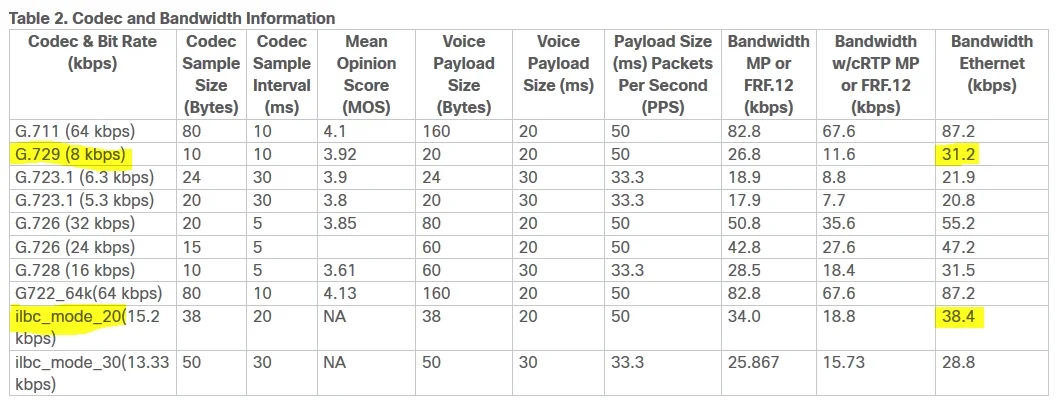
The correct answer is A. dial-peer voice 1 voip. With a link bandwidth of 160 kbps and a requirement for 5 concurrent calls, each call can consume at most 160/5 = 32 kbps. G.711 (PCMU/PCMA) requires approximately 80 kbps per call including IP/UDP/RTP overhead, which would far exceed the budget (5 × 80 = 400 kbps). G.729…
Question
A collaboration engineer must configure Cisco Unified Border Element to support up to five concurrent outbound calls across an Ethernet Link with a bandwidth of 160 kb to the Internet Telephony service provider. Which set of commands allows the engineer to complete the task without compromising voice quality?
Exhibit
Options
- Adial-peer voice 1 voip
- Bdial-peer voice 1 voip
- Cdial-peer voice 1 voip
- Ddial-peer voice 1 voip
How the community answered
(37 responses)- A70% (26)
- B8% (3)
- C19% (7)
- D3% (1)
Explanation
With a link bandwidth of 160 kbps and a requirement for 5 concurrent calls, each call can consume at most 160/5 = 32 kbps. G.711 (PCMU/PCMA) requires approximately 80 kbps per call including IP/UDP/RTP overhead, which would far exceed the budget (5 × 80 = 400 kbps). G.729 requires approximately 24–32 kbps per call with overhead (8 kbps payload + headers), which fits within the 32 kbps per-call budget (5 × 32 = 160 kbps). The correct dial-peer configuration (Option A) specifies codec g729r8 to enforce G.729 encoding and includes 'max-conn 5' under the dial-peer or voice class to cap concurrent calls at 5, ensuring bandwidth is not exceeded while maintaining acceptable voice quality.
Topics
Community Discussion
No community discussion yet for this question.