
350-801 · Question #376
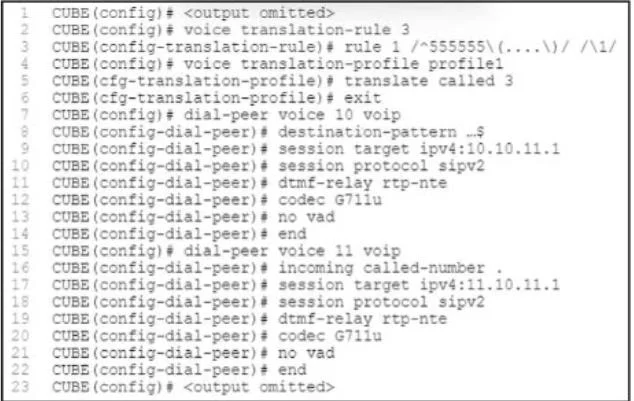
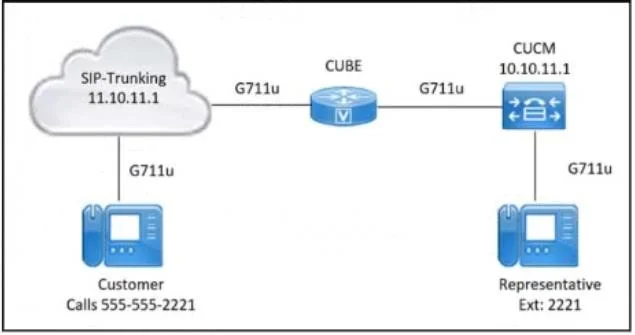
Refer to the exhibit. An engineer deploys this Cisco Unified Border Element configuration, but the phone at extension 2221 fails to ring. These configurations were performed already in Cisco UCM…
The correct answer is C. Apply voice translation-rule 3 to dial-peer 10 voip. To resolve a phone at extension 2221 failing to ring, applying 'voice translation-rule 3' to 'dial-peer voice 10' (presumably the inbound dial-peer from where calls to 2221 originate) is necessary to ensure the called number is correctly formatted for routing.
Question
Refer to the exhibit. An engineer deploys this Cisco Unified Border Element configuration, but the phone at extension 2221 fails to ring. These configurations were performed already in Cisco UCM:
- phone configuration and registration
- SIP trunk configuration
- translation pattern configuration
Which action resolves the issue?
Exhibits
Options
- AApply voice translation-rule 3 to dial-peer 11 voip.
- BChange the destination pattern for dial-peer voice 10 to 2... $.
- CApply voice translation-rule 3 to dial-peer 10 voip.
- DReplace voice translation-rule 3 with voice translation-rule 1.
How the community answered
(30 responses)- A7% (2)
- B3% (1)
- C73% (22)
- D17% (5)
Why each option
To resolve a phone at extension 2221 failing to ring, applying 'voice translation-rule 3' to 'dial-peer voice 10' (presumably the inbound dial-peer from where calls to 2221 originate) is necessary to ensure the called number is correctly formatted for routing.
Applying voice translation-rule 3 to dial-peer 11 voip might be incorrect if dial-peer 11 is not the relevant inbound dial-peer for calls to 2221 or if the rule is not intended for that specific dial-peer.
Changing the destination-pattern for dial-peer voice 10 to 2...$ might be a solution, but it directly changes the matching logic of the dial-peer; if voice translation-rule 3 already exists and is designed for the issue, applying it to the correct dial-peer is more targeted.
In Cisco CUBE, voice translation-rules are frequently applied to inbound dial-peers (e.g., dial-peer voice 10 if it's the inbound peer for calls destined to 2221) to modify the called number before routing. If an incoming call for 2221 fails to ring, it often indicates that the called number is not matching an outbound dial-peer or a UCM route pattern correctly, and voice translation-rule 3 likely contains the logic to normalize or transform the incoming number (e.g., adding/removing digits) so that it can be successfully routed to extension 2221, possibly via a SIP trunk to UCM.
Replacing voice translation-rule 3 with voice translation-rule 1 implies an entirely different rule set, which may or may not resolve the issue and could introduce new problems if rule 3 was partially correct or intended for other scenarios.
Concept tested: Cisco CUBE voice translation rules and dial-peer application
Source: https://www.cisco.com/c/en/us/td/docs/ios-xml/ios/voice/cube/configuration/cube-config-guide/cube-cfg-dial-peer.html
Topics
Community Discussion
No community discussion yet for this question.