
350-801 · Question #351
What is the traffic classification for voice and video conferencing?
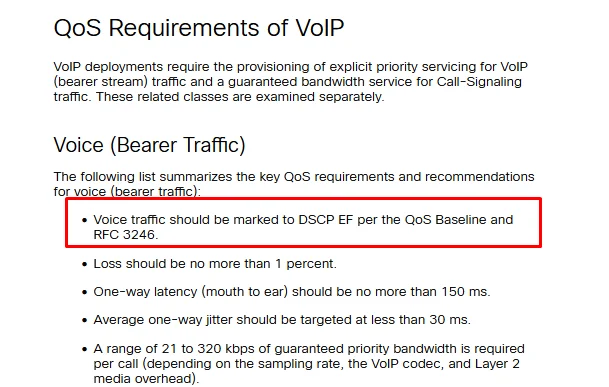
The correct answer is C. Voice is classified as CoS 5, and video conferencing is CoS 4. Cisco's recommended QoS models prioritize real-time traffic to ensure optimal quality for voice and video conferencing. Voice typically receives the highest priority, followed closely by interactive video.
Question
What is the traffic classification for voice and video conferencing?
Exhibit
Options
- AVoice is classified as CoS 4, and video conferencing is CoS 5.
- BVoice and video conferencing are both classified is CoS 3.
- CVoice is classified as CoS 5, and video conferencing is CoS 4.
- DVideo conferencing is classified as CoS 1, and voice is CoS 2.
How the community answered
(20 responses)- A5% (1)
- B5% (1)
- C90% (18)
Why each option
Cisco's recommended QoS models prioritize real-time traffic to ensure optimal quality for voice and video conferencing. Voice typically receives the highest priority, followed closely by interactive video.
This choice reverses the recommended priority, as voice should have higher priority than video conferencing.
Classifying both voice and video conferencing as CoS 3 would not provide the necessary differentiated treatment for real-time applications, potentially leading to quality issues.
Cisco's recommended QoS best practices assign CoS 5 (or DSCP EF) to voice traffic to minimize latency and jitter, and CoS 4 (or DSCP AF41) to interactive video conferencing to ensure a good quality experience, while still allowing voice to have precedence.
CoS 1 and 2 are typically reserved for less critical data or scavenger traffic, which is too low for real-time voice and video applications.
Concept tested: Cisco QoS traffic classification for voice and video
Source: https://www.cisco.com/c/en/us/td/docs/solutions/Enterprise/WAN_and_MAN/QoS_SRND/QoS-SRND-Book.html
Topics
Community Discussion
No community discussion yet for this question.