
350-801 · Question #349
What happens when a Cisco IP phone loses connectivity to the duster during an active call?
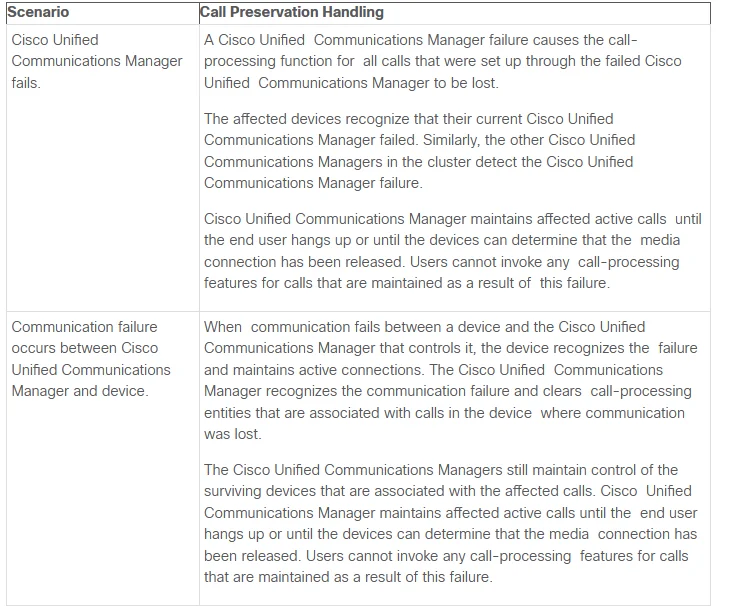
The correct answer is A. The call continues to be active, but features like transfer or hold do not work. When a Cisco IP phone loses connectivity to the UCM cluster during an active call, the RTP media stream continues directly between the two endpoints (peer-to-peer), keeping the voice path alive. However, since supplementary features like hold, transfer, and conference require…
Question
What happens when a Cisco IP phone loses connectivity to the duster during an active call?
Exhibit
Options
- AThe call continues to be active, but features like transfer or hold do not work.
- BThe call continues and all features work.
- CThe call drops immediately.
- DThe call drops after missing two keepalives from Cisco UCM.
How the community answered
(27 responses)- A93% (25)
- B4% (1)
- D4% (1)
Explanation
When a Cisco IP phone loses connectivity to the UCM cluster during an active call, the RTP media stream continues directly between the two endpoints (peer-to-peer), keeping the voice path alive. However, since supplementary features like hold, transfer, and conference require active signaling communication with Cisco UCM, those features stop working. The call itself is not dropped because RTP does not depend on UCM - only the call control signaling does. This is why Option A is correct: the call stays up but feature functionality is lost. Option D is a common distractor referencing the keepalive mechanism, but that applies to registration loss, not an in-progress call's media path.
Topics
Community Discussion
No community discussion yet for this question.