
350-801 · Question #171
What is a QoS requirement for VoIP calls?
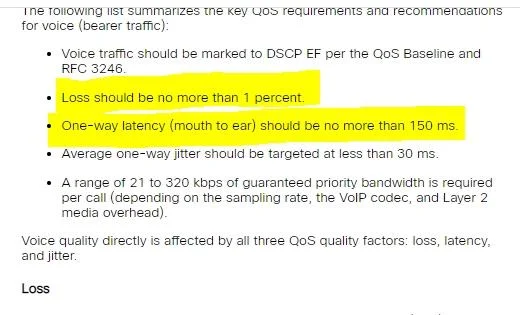
The correct answer is A. 150 ms of one-way latency from mouth to ear. For optimal voice quality in VoIP calls, a critical Quality of Service (QoS) requirement is to maintain one-way latency from mouth to ear at or below 150 milliseconds. Exceeding this threshold significantly degrades conversational quality.
Question
What is a QoS requirement for VoIP calls?
Exhibit
Options
- A150 ms of one-way latency from mouth to ear
- B15% packet loss
- C150 bps per phone of guaranteed bandwidth
- D150 ms of jitter
How the community answered
(58 responses)- A91% (53)
- B2% (1)
- C5% (3)
- D2% (1)
Why each option
For optimal voice quality in VoIP calls, a critical Quality of Service (QoS) requirement is to maintain one-way latency from mouth to ear at or below 150 milliseconds. Exceeding this threshold significantly degrades conversational quality.
A common and critical QoS requirement for acceptable voice quality in VoIP calls is to ensure that the one-way mouth-to-ear latency does not exceed 150 milliseconds. Latency greater than this value can lead to noticeable delays, causing speakers to talk over each other and significantly impacting the natural flow of conversation.
15% packet loss is an extremely high and unacceptable level for VoIP, as even 1% or 0.5% packet loss can lead to noticeable voice degradation and dropped words.
150 bps (bits per second) is an astronomically low and incorrect bandwidth figure for a VoIP call, which typically requires tens of kilobits per second (e.g., G.729 at 8-32 kbps, G.711 at 64-80 kbps).
150 ms of jitter is an unacceptably high level for VoIP; ideal jitter should be kept below 30 ms to prevent excessive de-jitter buffering, which adds to latency and can cause audio artifacts.
Concept tested: VoIP QoS requirements (latency)
Source: https://www.cisco.com/c/en/us/td/docs/voice_ip_comm/uc_system/design/guide/ucdg/qos.html
Topics
Community Discussion
No community discussion yet for this question.