
350-701 · Question #872
Refer to the exhibit. A network engineer must delete part of a Cisco router configuration using the NETCONF API. The engineer uses a Python script to automate the activity. Which code snippet…
The correct answer is A. <interface nc:operation="delete" xmlns:nc="urn:ietf:params:xml:ns:netconf:base:1.0"> </interface>. In NETCONF, the correct attribute to specify an operation on a configuration element is 'nc:operation', and the valid operation value for removing a configuration element is 'delete'. This is defined in RFC 6241, which specifies the NETCONF protocol operations, where 'delete'…
Question
Refer to the exhibit. A network engineer must delete part of a Cisco router configuration using the NETCONF API. The engineer uses a Python script to automate the activity. Which code snippet completes the script? A. B. C. D.
Exhibits
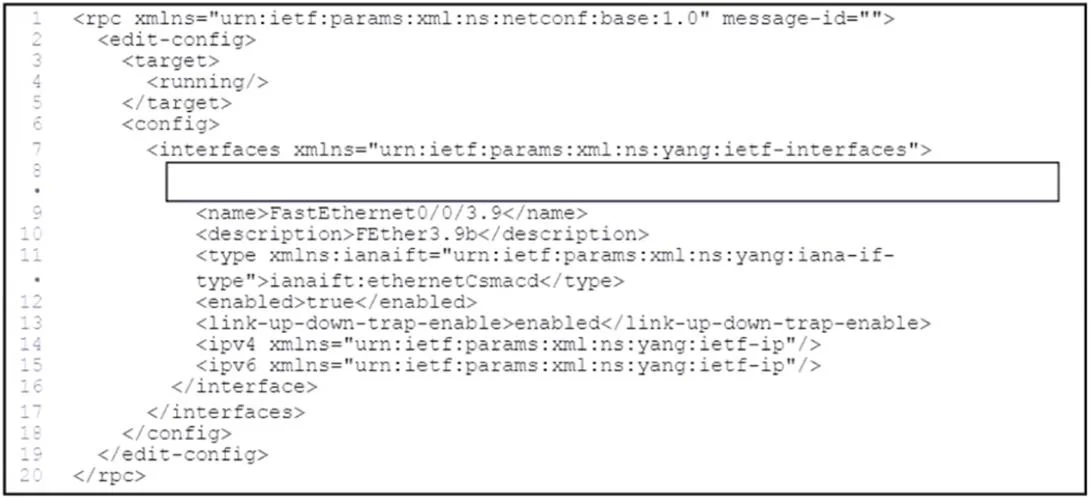




Options
- A<interface nc:operation="delete" xmlns:nc="urn:ietf:params:xml:ns:netconf:base:1.0"> </interface>
- B<interface nc:operation="change" xmlns:nc="urn:ietf:params:xml:ns:netconf:base:1.0"> </interface>
- C<interface nc:actions="delete" xmlns:nc="urn:ietf:params:xml:ns:netconf:base:1.0"> </interface>
- D<interface nc:operation="erase" xmlns:nc="urn:ietf:params:xml:ns:netconf:base:1.0"> </interface>
How the community answered
(32 responses)- A84% (27)
- B9% (3)
- C3% (1)
- D3% (1)
Explanation
In NETCONF, the correct attribute to specify an operation on a configuration element is 'nc:operation', and the valid operation value for removing a configuration element is 'delete'. This is defined in RFC 6241, which specifies the NETCONF protocol operations, where 'delete' removes the element from the target configuration datastore.
Topics
Community Discussion
No community discussion yet for this question.