
350-701 · Question #82
What two mechanisms are used to redirect users to a web portal to authenticate to ISE for guest services? (Choose two.)
The correct answer is B. central web auth E. local web auth. To redirect users to a web portal for guest authentication with Cisco ISE, the two primary mechanisms are Central Web Authentication (CWA) and Local Web Authentication (LWA). These methods direct the client's web browser to an ISE portal for credential entry and policy…
Question
What two mechanisms are used to redirect users to a web portal to authenticate to ISE for guest services? (Choose two.)
Exhibit
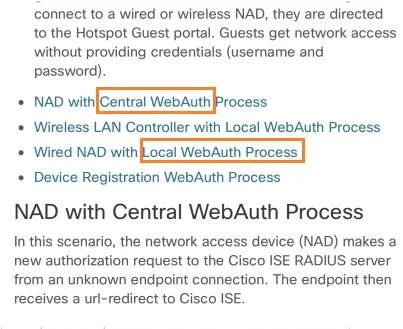
Options
- ATACACS+
- Bcentral web auth
- Csingle sign-on
- Dmultiple factor auth
- Elocal web auth
How the community answered
(22 responses)- B91% (20)
- C5% (1)
- D5% (1)
Why each option
To redirect users to a web portal for guest authentication with Cisco ISE, the two primary mechanisms are Central Web Authentication (CWA) and Local Web Authentication (LWA). These methods direct the client's web browser to an ISE portal for credential entry and policy enforcement.
TACACS+ is used for device administration authentication and authorization, not for redirecting end-users to a web portal for guest services.
Central Web Authentication (CWA) is a common mechanism where the client is redirected by the network device (e.g., switch or WLC) to a web portal hosted on Cisco ISE itself for authentication, after which ISE provides the authorization decision.
Single sign-on (SSO) is an authentication scheme, but it's not a *redirection mechanism* for initial web portal access.
Multifactor authentication (MFA) is an authentication method, not a mechanism for redirecting users to a web portal.
Local Web Authentication (LWA) is another method where the client is redirected by the network device to a web portal that is hosted on the network device (e.g., WLC or router) itself, which then proxies the authentication request to ISE or a local database.
Concept tested: Cisco ISE web authentication redirection
Source: https://www.cisco.com/c/en/us/td/docs/security/ise/2-1/ise_admin_guide/b_ise_admin_guide_21/b_ise_admin_guide_21_chapter_010000.html
Topics
Community Discussion
No community discussion yet for this question.