
350-701 · Question #708
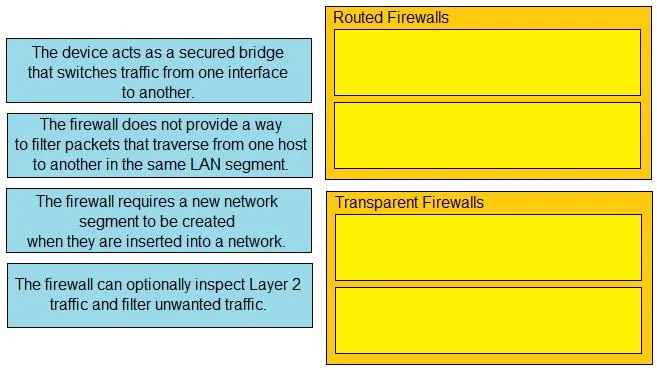
Drag and Drop Question Drag and drop the firewall capabilities from the left onto the corresponding firewall deployment modes on the right. Answer:
The correct answer is The firewall does not provide a way to filter packets that traverse from one host to another in the same LAN segment.; The firewall requires a new network segment to be created when they are inserted into a network.; The device acts as a secured bridge that switches traffic from one interface to another.; The firewall can optionally inspect Layer 2 traffic and filter unwanted traffic. In routed mode, the firewall acts as a Layer 3 hop and requires a new network segment to be created when inserted into a network, since each interface resides in a different subnet. In transparent (bridged) mode, the firewall acts as a secured Layer 2 bridge that switches…
Question
Drag and Drop Question Drag and drop the firewall capabilities from the left onto the corresponding firewall deployment modes on the right. Answer:
Exhibit
Answer Area
Drag items
Correct arrangement
- The firewall does not provide a way to filter packets that traverse from one host to another in the same LAN segment.
- The firewall requires a new network segment to be created when they are inserted into a network.
- The device acts as a secured bridge that switches traffic from one interface to another.
- The firewall can optionally inspect Layer 2 traffic and filter unwanted traffic.
Explanation
In routed mode, the firewall acts as a Layer 3 hop and requires a new network segment to be created when inserted into a network, since each interface resides in a different subnet. In transparent (bridged) mode, the firewall acts as a secured Layer 2 bridge that switches traffic between interfaces without requiring IP re-addressing, can optionally inspect Layer 2 traffic to filter unwanted content, but cannot filter traffic between hosts on the same LAN segment since that traffic does not traverse the firewall. These distinctions map directly to the architectural differences between routed and transparent deployment modes.
Topics
Community Discussion
No community discussion yet for this question.