
350-701 · Question #60
What are two Detection and Analytics Engines of Cognitive Threat Analytics? (Choose two.)
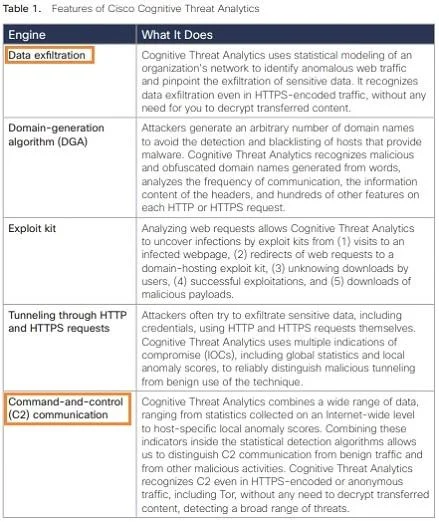
The correct answer is A. data exfiltration B. command and control communication. Cisco Cognitive Threat Analytics uses detection and analytics engines like data exfiltration and command and control communication to identify sophisticated threats.
Question
What are two Detection and Analytics Engines of Cognitive Threat Analytics? (Choose two.)
Exhibit
Options
- Adata exfiltration
- Bcommand and control communication
- Cintelligent proxy
- Dsnort
- EURL categorization
How the community answered
(18 responses)- A89% (16)
- D6% (1)
- E6% (1)
Why each option
Cisco Cognitive Threat Analytics uses detection and analytics engines like data exfiltration and command and control communication to identify sophisticated threats.
Data exfiltration is a specific type of malicious activity that Cognitive Threat Analytics is designed to detect, identifying attempts to illicitly transfer data out of a network.
Command and control (C2) communication is a key indicator of compromise, and Cognitive Threat Analytics focuses on detecting these covert channels used by attackers to control compromised systems.
An intelligent proxy is a network component that mediates traffic and provides security services, but it is not a detection and analytics engine within CTA itself.
Snort is an open-source intrusion prevention system (IPS) engine, distinct from Cognitive Threat Analytics' specialized behavioral analysis engines.
URL categorization is a function of web filtering for content classification, not a core detection and analytics engine within Cognitive Threat Analytics.
Concept tested: Cisco Cognitive Threat Analytics engines
Source: https://www.cisco.com/c/en/us/products/collateral/security/cognitive-threat-analytics/qa_c67-732560.html
Topics
Community Discussion
No community discussion yet for this question.