
350-701 · Question #497
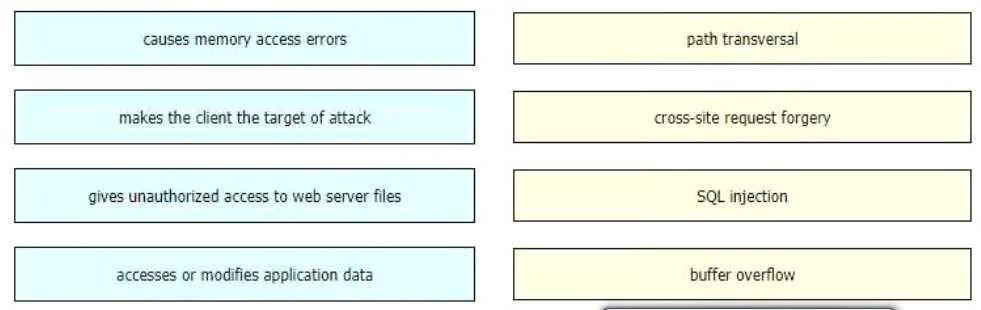
Drag and Drop Question Drag and drop the exploits from the left onto the type of security vulnerability on the right. Answer:
The correct matching pairs are: Buffer overflow → causes memory access errors (buffer overflows write beyond allocated memory boundaries, corrupting adjacent memory); Cross-site request forgery (CSRF) → makes the client the target of attack (CSRF tricks the victim's browser…
Question
Drag and Drop Question Drag and drop the exploits from the left onto the type of security vulnerability on the right. Answer:
Exhibit
Explanation
The correct matching pairs are: Buffer overflow → causes memory access errors (buffer overflows write beyond allocated memory boundaries, corrupting adjacent memory); Cross-site request forgery (CSRF) → makes the client the target of attack (CSRF tricks the victim's browser into sending malicious requests, targeting the end user/client); Path traversal → gives unauthorized access to web server files (path traversal uses sequences like '../' to navigate outside the web root and access restricted server files); SQL injection → accesses or modifies application data (SQL injection inserts malicious SQL code into queries to read, alter, or delete database contents). Each exploit maps precisely to its defining characteristic - buffer overflow is a memory-level attack, CSRF exploits client-side trust, path traversal targets the file system, and SQL injection targets the data layer.
Topics
Community Discussion
No community discussion yet for this question.