
350-701 · Question #314
A customer has various external HTTP resources available including Intranet Extranet and Internet, with a proxy configuration running in explicit mode. Which method allows the client desktop…
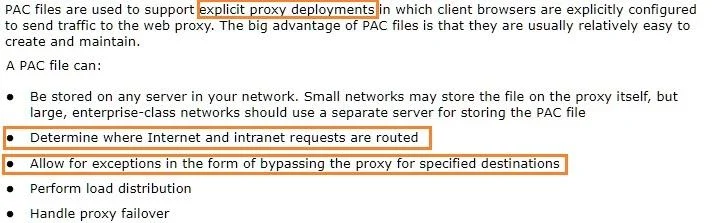
The correct answer is C. PAC file. A PAC (Proxy Auto-Configuration) file is used to configure client desktop browsers to dynamically decide whether to connect directly to a resource or through an explicit proxy, based on predefined JavaScript rules.
Question
A customer has various external HTTP resources available including Intranet Extranet and Internet, with a proxy configuration running in explicit mode. Which method allows the client desktop browsers to be configured to select when to connect direct or when to use the proxy?
Exhibit
Options
- ATransport mode
- BForward file
- CPAC file
- DBridge mode
How the community answered
(40 responses)- A5% (2)
- B10% (4)
- C83% (33)
- D3% (1)
Why each option
A PAC (Proxy Auto-Configuration) file is used to configure client desktop browsers to dynamically decide whether to connect directly to a resource or through an explicit proxy, based on predefined JavaScript rules.
Transport mode is a term used in IPsec to describe how traffic is encrypted, and is not related to client-side proxy auto-configuration.
Forward file is not a standard or recognized method for client-side proxy auto-configuration.
A PAC file contains a JavaScript function that web browsers execute to determine, based on the URL and other factors, whether to directly access a resource or route the request through a proxy server.
Bridge mode describes a networking operating mode, typically at Layer 2, and is unrelated to client-side proxy configuration for HTTP resources.
Concept tested: Proxy Auto-Configuration (PAC)
Source: https://developer.mozilla.org/en-US/docs/Web/HTTP/Proxy_servers_and_tunneling/Proxy_Auto-Configuration_(PAC)_file
Topics
Community Discussion
No community discussion yet for this question.