
350-701 · Question #237
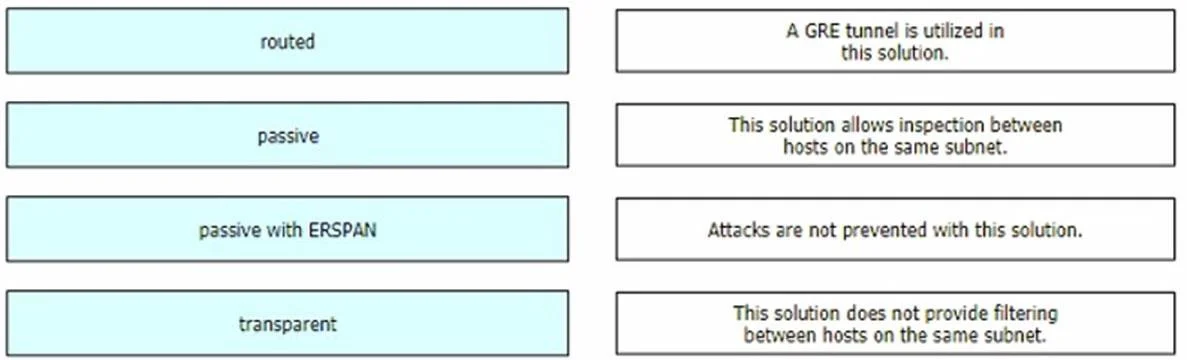
Drag and Drop Question Drag and drop the deployment models from the left onto the explanations on the right. Answer:
The correct answer is routed; passive; passive with ERSPAN; transparent. The correct arrangement maps each deployment model to its defining characteristic: 'routed' mode places the IPS inline as a Layer 3 hop that actively forwards and can block traffic; 'passive' mode monitors a copy of traffic (via SPAN/tap) without being in the traffic path…
Question
Exhibit
Answer Area
Drag items
Correct arrangement
- routed
- passive
- passive with ERSPAN
- transparent
Explanation
The correct arrangement maps each deployment model to its defining characteristic: 'routed' mode places the IPS inline as a Layer 3 hop that actively forwards and can block traffic; 'passive' mode monitors a copy of traffic (via SPAN/tap) without being in the traffic path; 'passive with ERSPAN' extends passive monitoring across routed network boundaries using encapsulated remote SPAN; and 'transparent' (inline tap/bridge) mode places the sensor inline at Layer 2 without an IP address, allowing it to inspect and block traffic while appearing invisible to the network. Each model represents a distinct balance between visibility, active enforcement capability, and network impact.
Topics
Community Discussion
No community discussion yet for this question.