
350-601 · Question #558
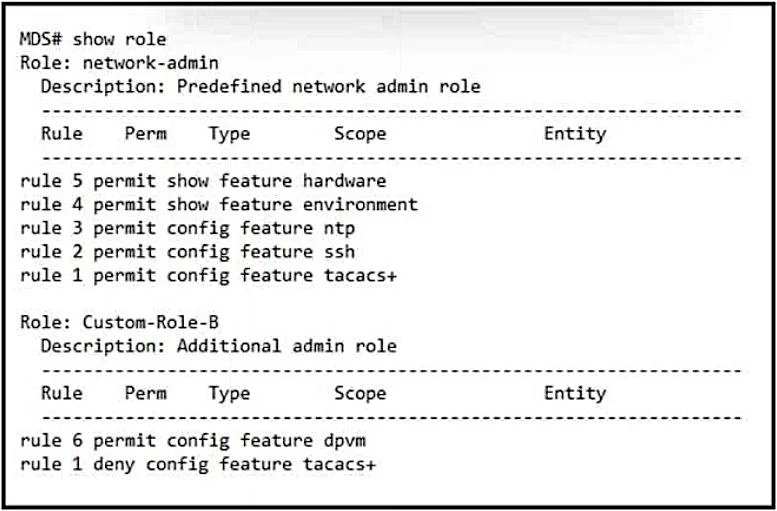
Refer to the exhibit. A Cisco MDS 9000 Series Switch is configured with RBAC. The default role applies to all users. User A is also assigned to the role Custom-Role-B. Which set of features will…
The correct answer is B. SSH. In Cisco MDS RBAC, when a user is assigned multiple roles, the effective permissions are the union of all assigned roles. The default role on MDS provides a baseline set of permissions applied to all users (typically limited read or certain show commands). Based on the exhibit…
Question
Refer to the exhibit. A Cisco MDS 9000 Series Switch is configured with RBAC. The default role applies to all users. User A is also assigned to the role Custom-Role-B. Which set of features will user A be authorized to configure?
Exhibit
Options
- ANTP
- BSSH
- CDPVM
- Dhardware
How the community answered
(30 responses)- B90% (27)
- C3% (1)
- D7% (2)
Explanation
In Cisco MDS RBAC, when a user is assigned multiple roles, the effective permissions are the union of all assigned roles. The default role on MDS provides a baseline set of permissions applied to all users (typically limited read or certain show commands). Based on the exhibit, Custom-Role-B grants permission to configure SSH but not NTP, DPVM, or hardware features. Those other features (NTP, DPVM, hardware) are either restricted to higher-privilege roles not assigned to User A, or explicitly not included in Custom-Role-B's rule set. Since the union of the default role and Custom-Role-B includes SSH configuration rights, SSH is the feature User A is authorized to configure. DPVM typically requires a Storage Admin or equivalent role, and hardware configuration requires an Administrator role.
Topics
Community Discussion
No community discussion yet for this question.