350-601 · Question #446
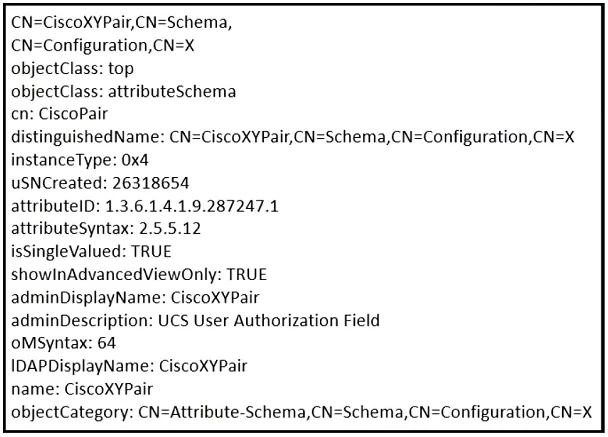
Refer to the exhibit. A network engineer must configure an authentication solution for Cisco UCS with these conditions: - Two-factor authentication must be enabled for all UCS user authentication…
The correct answer is C. Remove the LDAP provider. To enable two-factor authentication and ensure AAA packets are encrypted using TCP port 49 for Cisco UCS, the LDAP provider should be removed, as these requirements are typically met by configuring a RADIUS or TACACS+ server.
Question
Refer to the exhibit. A network engineer must configure an authentication solution for Cisco UCS with these conditions:
- Two-factor authentication must be enabled for all UCS user
authentication.
- All AAA packets must be encrypted and use TCP port 49 to establish
communication. Which set of actions needs these requirements?
Exhibit
Options
- ACreate the LDAP provider.
- BCreate the RADIUS group mapping.
- CRemove the LDAP provider.
- DDelete the LDAP group mapping.
How the community answered
(37 responses)- A8% (3)
- B3% (1)
- C76% (28)
- D14% (5)
Why each option
To enable two-factor authentication and ensure AAA packets are encrypted using TCP port 49 for Cisco UCS, the LDAP provider should be removed, as these requirements are typically met by configuring a RADIUS or TACACS+ server.
Creating an LDAP provider would likely conflict with the requirements for two-factor authentication and full AAA packet encryption on TCP port 49 (TACACS+), as standard LDAP typically uses TCP 389 (unsecured) or 636 (LDAPS/encrypted).
Creating a RADIUS group mapping is a step towards implementing RADIUS, but the question asks for an action that *needs* these requirements, implying a change from a non-compliant state; removing the non-compliant LDAP provider would be a necessary prerequisite.
Two-factor authentication and the use of TCP port 49 (standard for TACACS+) or secure RADIUS (which encrypts entire packets) are characteristic features of RADIUS or TACACS+ implementations. LDAP, if not configured with LDAPS, does not provide full packet encryption and native two-factor authentication is not an inherent feature, making its removal necessary to implement a compliant solution.
Deleting an LDAP group mapping removes specific authorization rules but does not eliminate the underlying LDAP authentication provider, which may still not meet the two-factor and encryption requirements.
Concept tested: Cisco UCS authentication providers (LDAP vs. RADIUS/TACACS+) and their features.
Source: https://www.cisco.com/c/en/us/td/docs/unified_computing/ucs/sw/gui/config/guide/3-1/b_UCSM_GUI_Configuration_Guide_3_1/b_UCSM_GUI_Configuration_Guide_3_1_chapter_01000010.html
Topics
Community Discussion
No community discussion yet for this question.
