
350-601 · Question #284
A Cisco UCS user called "Employee1" accidentally changed the boot policy of the Cisco UCS server at the Cisco UCS Manager root level. This change impacted all service profiles and their storage…
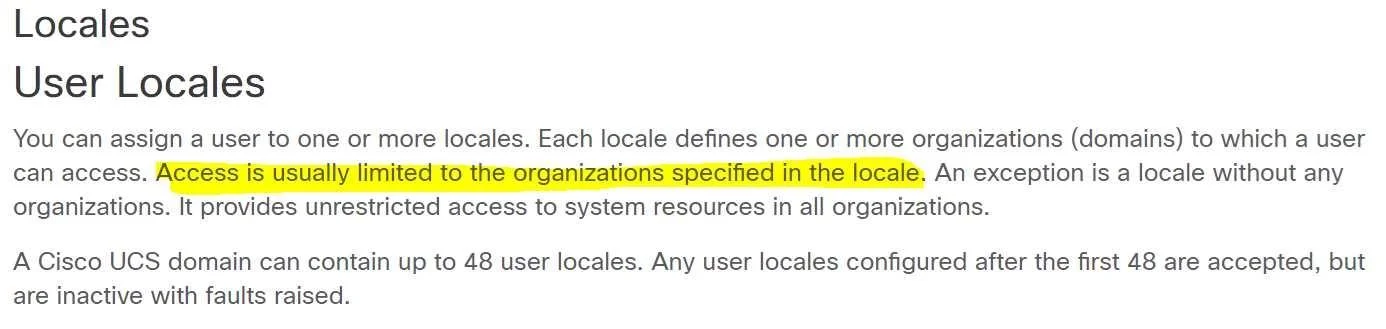
The correct answer is D. Assign users to a specific Cisco UCS locale. Cisco UCS Manager uses two orthogonal access control constructs: roles and locales. Roles define WHAT a user can do (e.g., read vs. write, which object types). Locales define WHERE a user can operate - which organizations in the UCS hierarchy they can access. By assigning a…
Question
A Cisco UCS user called "Employee1" accidentally changed the boot policy of the Cisco UCS server at the Cisco UCS Manager root level. This change impacted all service profiles and their storage connectivity was lost. The system administrator wants to prevent this issue from recurring in the future. The new security policy mandates that access must be restricted up to the organization level and prevent other users from modifying root policies. Which action must be taken to meet these requirements?
Exhibit
Options
- AModify the privilege level assigned to the user
- BDefine a custom user role and assign it to users
- CAssign the user "Employee1" the network-operator role
- DAssign users to a specific Cisco UCS locale
How the community answered
(27 responses)- A4% (1)
- B4% (1)
- C11% (3)
- D81% (22)
Explanation
Cisco UCS Manager uses two orthogonal access control constructs: roles and locales. Roles define WHAT a user can do (e.g., read vs. write, which object types). Locales define WHERE a user can operate - which organizations in the UCS hierarchy they can access. By assigning a user to a locale scoped to a specific sub-organization, they are prevented from viewing or modifying objects at the root level or other organizations. This is the correct mechanism to enforce organizational boundary restrictions. Simply modifying privilege level or assigning a standard role (like network-operator) controls capability, not organizational scope. Custom roles also address the 'what', not the 'where' - only locales restrict the organizational scope.
Topics
Community Discussion
No community discussion yet for this question.