
350-601 · Question #282
An environment consists of a Cisco MDS 9000 Series Switch that uses port channels. An engineer must ensure that frames between the source and the destination follow the same links for a specific…
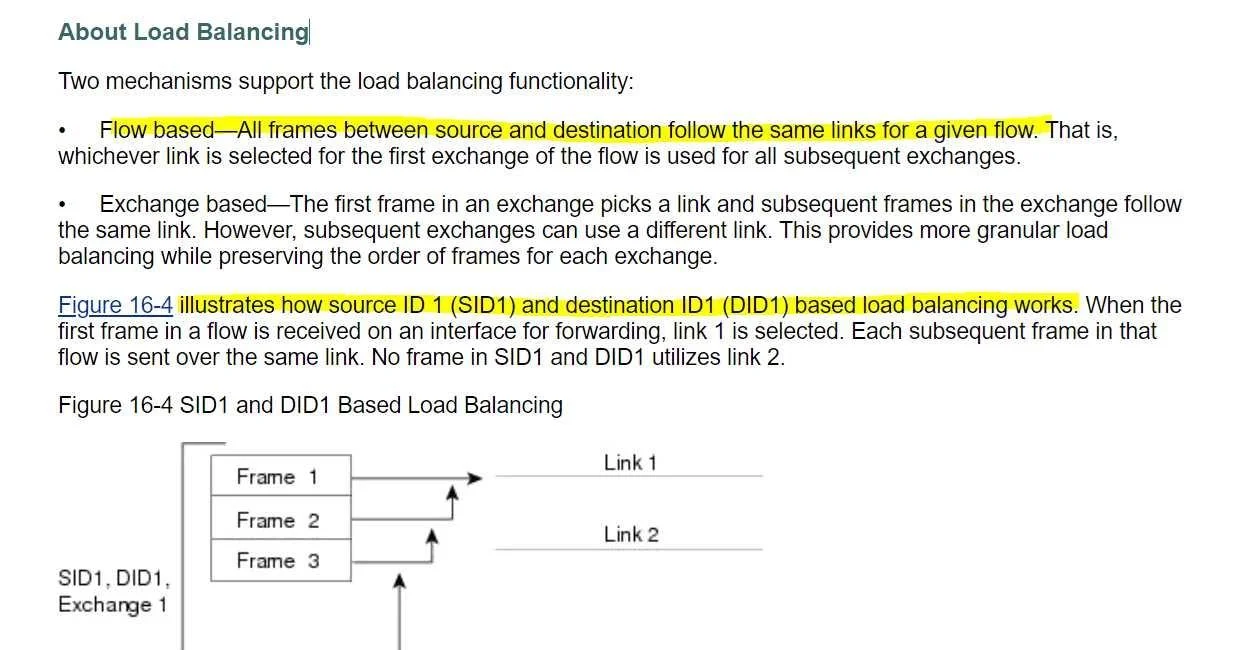
The correct answer is A. src-id/dst-id. On Cisco MDS 9000, the 'src-id/dst-id' load balancing method uses the source port ID and destination port ID (FCID) as the hash key. This ensures that all frames belonging to a specific flow (same source and destination) are always hashed to the same link in the port channel…
Question
An environment consists of a Cisco MDS 9000 Series Switch that uses port channels. An engineer must ensure that frames between the source and the destination follow the same links for a specific flow. Subsequent flows are allowed to use a different link Which load balancing method should be used to accomplish this goal?
Exhibit
Options
- Asrc-id/dst-id
- Bsrc-dst-oui
- Csrc-dst-port
- Dsrc-id/dst-id/oxid
How the community answered
(51 responses)- A90% (46)
- B2% (1)
- C2% (1)
- D6% (3)
Explanation
On Cisco MDS 9000, the 'src-id/dst-id' load balancing method uses the source port ID and destination port ID (FCID) as the hash key. This ensures that all frames belonging to a specific flow (same source and destination) are always hashed to the same link in the port channel, satisfying the requirement that frames follow the same link for a given flow. Different source/destination pairs can hash to different links, allowing subsequent flows to use different links. The 'src-id/dst-id/oxid' method adds the Originator Exchange ID (OX_ID) to the hash, which can spread frames of the same conversation across multiple links - violating the requirement for same-link forwarding per flow.
Topics
Community Discussion
No community discussion yet for this question.