
350-501 · Question #493
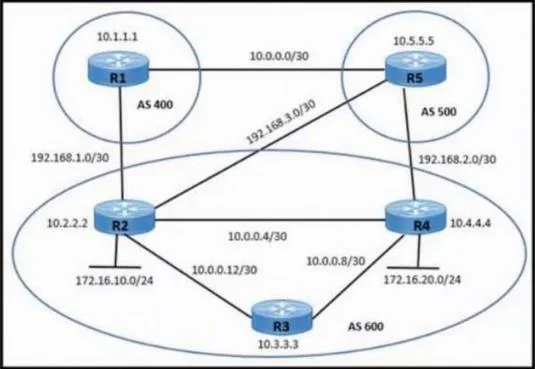
Refer to the exhibit. An engineer working for a private service provider with an employee ID: 1234:56:789 is configuring BGP in AS 400, AS 500, and AS 600 to set up BGP peering. The engineer…
The correct answer is D. Configure route-map blockprefix in under BGP on R1 and R5. To stop receiving the prefix 172.16.10.0/24 in the BGP routing table on R1 and R5, a route-map should be applied with the appropriate filtering logic. By configuring the route-map blockprefix as an inbound filter on R1 and R5, the prefix will be blocked as it is advertised to…
Question
Refer to the exhibit. An engineer working for a private service provider with an employee ID:
1234:56:789 is configuring BGP in AS 400, AS 500, and AS 600 to set up BGP peering. The engineer reported that 172.16.10.0/24 is not installed in the R2 RIB. RI and R5 receive the prefix 172.16.10.0/24 in the BGP routing table. Which configuration must be implemented to stop receiving prefix 172.16.10.0/24 in the BGP table?
Exhibit
Options
- AConfigure bgp suppress-inactive under BGP address-family ipv4 unicast on R2.
- BConfigure bgp suppress-inactive under BGP address-family ipv4 unicast on R1 and R5.
- CConfigure route-map blockprefix out under BGP on R2.
- DConfigure route-map blockprefix in under BGP on R1 and R5.
How the community answered
(56 responses)- A5% (3)
- B4% (2)
- C9% (5)
- D82% (46)
Explanation
To stop receiving the prefix 172.16.10.0/24 in the BGP routing table on R1 and R5, a route-map should be applied with the appropriate filtering logic. By configuring the route-map blockprefix as an inbound filter on R1 and R5, the prefix will be blocked as it is advertised to these routers. This ensures that R1 and R5 do not install the unwanted prefix in their BGP tables, effectively preventing its propagation across the network. Inbound filtering is a standard approach to control what routes are accepted by a BGP peer.
Topics
Community Discussion
No community discussion yet for this question.