
350-501 · Question #447
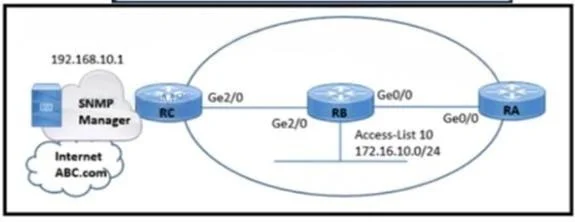
Refer to the exhibit. A network engineer is configuring an SNMP community on router RB with these requirements: - Allow read-only access for all objects to members of Access-List 10 that use the…
The correct answer is A. Option A. To configure SNMP on router RB according to the requirements, a read-only community string comaccess must be associated with Access-List 10, all other access denied implicitly, and authentication failure traps explicitly enabled and sent to a specified SNMPv2c host using the…
Question
Refer to the exhibit. A network engineer is configuring an SNMP community on router RB with these requirements:
- Allow read-only access for all objects to members of Access-List 10
that use the comaccess community string.
- Other SNMP managers must not have access to objects.
- SNMP authentication failure traps must be sent to SNMPv2c and then to
the host using SNMPv2c with the public community string. Which configuration meets these requirements?
Exhibits
Options
- AOption A
- BOption B
- COption C
- DOption D
How the community answered
(37 responses)- A73% (27)
- B8% (3)
- C5% (2)
- D14% (5)
Why each option
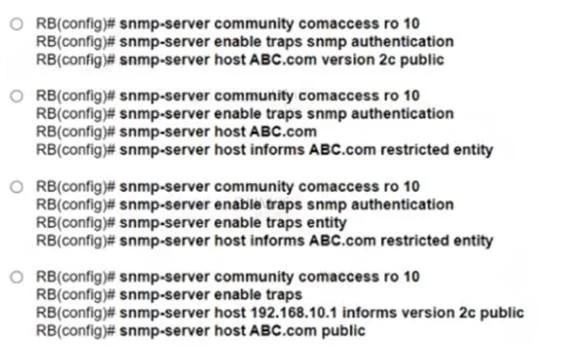
To configure SNMP on router RB according to the requirements, a read-only community string `comaccess` must be associated with `Access-List 10`, all other access denied implicitly, and authentication failure traps explicitly enabled and sent to a specified SNMPv2c host using the `public` community string.
Option A correctly configures the `snmp-server community comaccess ro 10` command to grant read-only access to devices permitted by `Access-List 10` using the `comaccess` string, implicitly denying others. It also includes `snmp-server enable traps snmp authentication` to send authentication failure traps and `snmp-server host <trap_receiver_IP> version 2c public` to direct these traps to the specified host with the `public` community string.
Assuming Option B does not meet all specified requirements, such as incorrectly configuring the community string, failing to associate it with Access-List 10, or improperly setting up trap reception.
Assuming Option C does not meet all specified requirements, such as incorrectly configuring the community string, failing to associate it with Access-List 10, or improperly setting up trap reception.
Assuming Option D does not meet all specified requirements, such as incorrectly configuring the community string, failing to associate it with Access-List 10, or improperly setting up trap reception.
Concept tested: SNMPv2c community string, access-list for SNMP, and trap configuration
Source: https://www.cisco.com/c/en/us/td/docs/ios-xml/ios/snmp/configuration/xe-16/snmp-xe-16-book/snmp-cfg.html
Topics
Community Discussion
No community discussion yet for this question.