
350-501 · Question #368
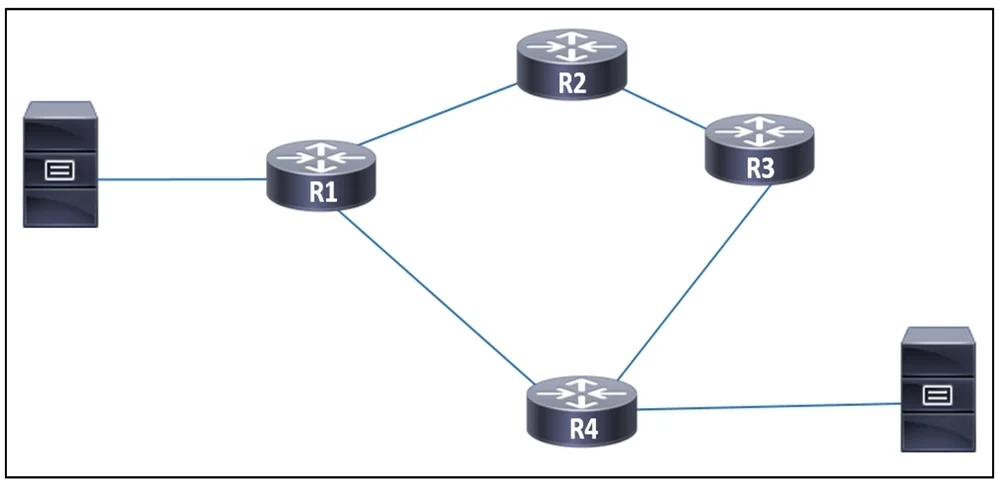
Refer to the exhibit. A network engineer observed congestion between routers R1 and R4, which are connected on a point-to-point link. Two servers that reside on networks on R1 and R4 generate heavy…
The correct answer is A. Implement traffic policing to drop packets that exceed the given threshold. To resolve congestion on the R4-R1 link by dropping inbound packets exceeding a threshold from R4 to R1 without affecting R4 to R3 traffic, traffic policing must be implemented on R4's interface towards R1 in the inbound direction.
Question
Refer to the exhibit. A network engineer observed congestion between routers R1 and R4, which are connected on a point-to-point link. Two servers that reside on networks on R1 and R4 generate heavy traffic between them with most traffic going from R4 to R1. To improve overall performance, the engineer wants to drop inbound packets that exceed a configured threshold, without disrupting traffic that passes from R4 to R3. Which action must the engineer take to resolve the issue?
Exhibit
Options
- AImplement traffic policing to drop packets that exceed the given threshold.
- BImplement FIFO to queue excess traffic for transmission when bandwidth is available.
- CImplement traffic shaping to drop excess packets.
- DImplement a service policy in the outbound direction on each interface on the link to tag traffic
How the community answered
(51 responses)- A84% (43)
- B10% (5)
- C4% (2)
- D2% (1)
Why each option
To resolve congestion on the R4-R1 link by dropping inbound packets exceeding a threshold from R4 to R1 without affecting R4 to R3 traffic, traffic policing must be implemented on R4's interface towards R1 in the inbound direction.
Traffic policing is the appropriate QoS mechanism for immediately dropping packets that exceed a defined rate threshold, especially when applied inbound on an interface. This directly addresses the requirement to 'drop inbound packets that exceed a configured threshold' on the congested R4-R1 link, where traffic from R4 to R1 is heavy.
FIFO queuing simply processes packets in the order they arrive and does not actively drop traffic that exceeds a threshold; instead, it queues it, which is contrary to the requirement of dropping excess packets.
Traffic shaping typically buffers excess packets for later transmission to smooth out traffic bursts, rather than immediately dropping them as requested.
Implementing a service policy to tag traffic is a classification and marking mechanism for QoS, not a congestion management technique that drops excess packets.
Concept tested: QoS traffic policing vs. shaping
Source: https://www.cisco.com/c/en/us/td/docs/ios/qos/configuration/guide/12_2sr/qos_12_2sr_book/qos_pol_shaping.html
Topics
Community Discussion
No community discussion yet for this question.