
350-501 · Question #256
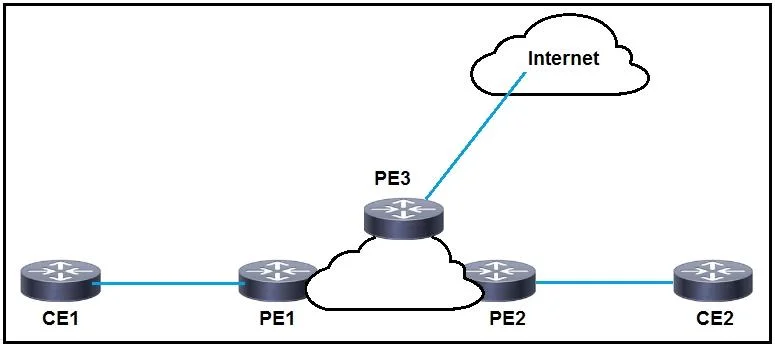
Refer to the exhibit. CE1 and CE2 require connectivity to the internet through the ISP connected to PE3. What should an engineer configure to complete this task?
The correct answer is A. PE2 must be configured to serve as a route reflector for PE3 routes learned from the internet. PE2. To provide Internet connectivity from CE1 and CE2 via PE3, PE2 should be configured as a route reflector for the routes PE3 learns from the Internet. This ensures that the Internet routes received by PE3 are propagated to other PE routers, including PE1, allowing CE1 and CE2 to…
Question
Refer to the exhibit. CE1 and CE2 require connectivity to the internet through the ISP connected to PE3. What should an engineer configure to complete this task?
Exhibit
Options
- APE2 must be configured to serve as a route reflector for PE3 routes learned from the internet. PE2
- BCE1 and CE2 must be configured with a route distinguisher in the PE1 VRF that dynamically
- CCE1 and CE2 must be configured to use a static default route with a next-hop of PE3 to reach
- DPE1 must be configured with an import route target in the CE1 VRF that matches the export route
How the community answered
(38 responses)- A82% (31)
- B5% (2)
- C3% (1)
- D11% (4)
Why each option
To provide Internet connectivity from CE1 and CE2 via PE3, PE2 should be configured as a route reflector for the routes PE3 learns from the Internet. This ensures that the Internet routes received by PE3 are propagated to other PE routers, including PE1, allowing CE1 and CE2 to reach the Internet.
In a typical MPLS VPN setup where PE routers form an iBGP mesh, a route reflector is used to simplify the iBGP peering and allow routes learned by one PE from an external network (like the Internet on PE3) to be propagated to other PEs (like PE1). PE2 serving as a route reflector ensures PE1 learns the Internet routes from PE3, which can then be injected into the VRFs for CE1 and CE2.
Route distinguishers are used to make routes unique within the BGP routing table for different VRFs, but they don't directly provide Internet connectivity.
CE1 and CE2 are customer edge devices; they should typically receive default routes from their directly connected PE (PE1), not directly from PE3, as PE3 is not directly connected to them.
An import route target on PE1 matching an export route target from PE3 would allow specific VPN routes to be exchanged, but it doesn't directly address the propagation of Internet routes across the iBGP domain to provide default Internet access for CE1/CE2 through PE3.
Concept tested: MPLS VPN Internet access with BGP route reflector
Source: https://www.cisco.com/c/en/us/td/docs/ios/iproute_bgp/configuration/guide/irg_rr.html
Topics
Community Discussion
No community discussion yet for this question.