
350-401 · Question #918
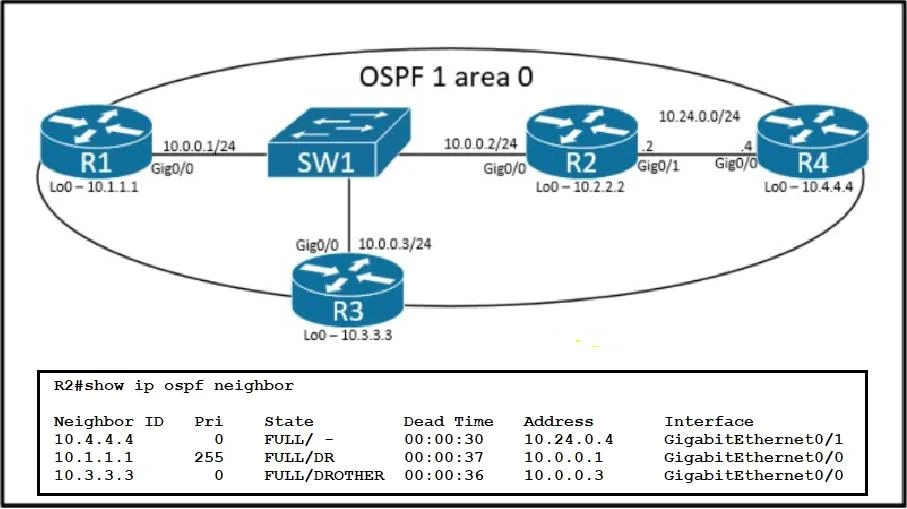
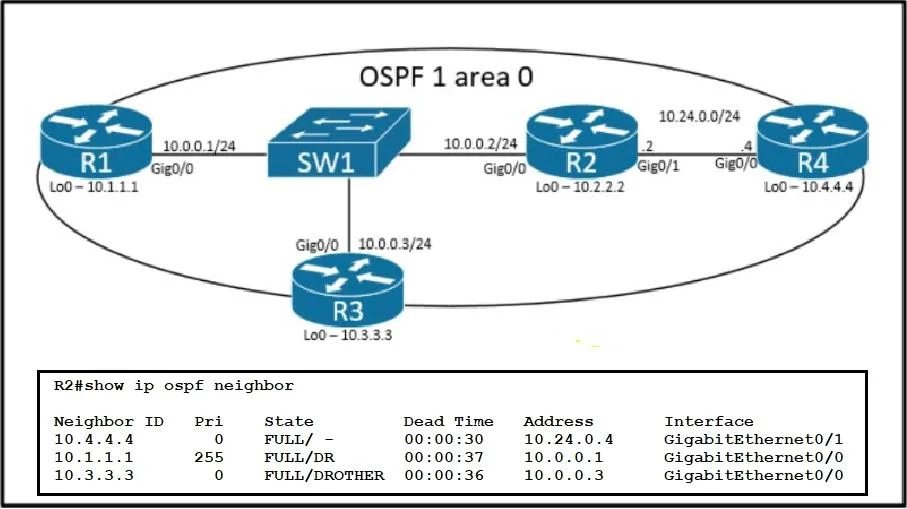
Refer to the exhibit. An engineer must reduce the number of Type 1 and Type 2 LSAs that are advertised to R4 within OSPF area 0. Which configuration must be applied?
The correct answer is A. R1# conf t. Configuring an OSPF area as Not-So-Stubby Area (NSSA) allows external routes to be injected into it as Type 7 LSAs while restricting other external LSA types from entering, thus contributing to overall LSA reduction.
Question
Refer to the exhibit. An engineer must reduce the number of Type 1 and Type 2 LSAs that are advertised to R4 within OSPF area 0. Which configuration must be applied?
Exhibits
Options
- AR1# conf t
- BR4# conf t
- CR2# conf t
- DR2# conf t
How the community answered
(29 responses)- A45% (13)
- B7% (2)
- C31% (9)
- D17% (5)
Why each option
Configuring an OSPF area as Not-So-Stubby Area (NSSA) allows external routes to be injected into it as Type 7 LSAs while restricting other external LSA types from entering, thus contributing to overall LSA reduction.
An NSSA (Not-So-Stubby Area) configuration on an Area Border Router (ABR) such as R1 for a specific area (even if 'area 0' is used contextually for a non-backbone NSSA area) is primarily designed to control the propagation of external routes. It converts Type 5 LSAs into Type 7 LSAs for internal area routing, preventing the flooding of external Type 5 LSAs, which helps reduce the LSA database size and improves convergence, although it does not directly reduce Type 1 or Type 2 LSAs within an area.
Configuring R4 as an NSSA area border router would not achieve the stated goal, and Area 0 itself cannot be configured as an NSSA area as it is the backbone.
Configuring a stub area on R2 would prevent Type 5 and Type 4 LSAs from entering that area, but it does not directly address the reduction of Type 1 and Type 2 LSAs within Area 0 and does not fit the NSSA context implied by the correct answer.
Configuring an NSSA Totally Stubby Area (no-summary) on R2 would prevent Type 3, 4, and 5 LSAs from entering that area; while reducing LSA types, it doesn't align with the specific choice A and Type 1/2 LSAs.
Concept tested: OSPF area types and LSA reduction
Source: https://www.cisco.com/c/en/us/support/docs/ip/open-shortest-path-first-ospf/13689-18.html
Topics
Community Discussion
No community discussion yet for this question.