
350-401 · Question #833
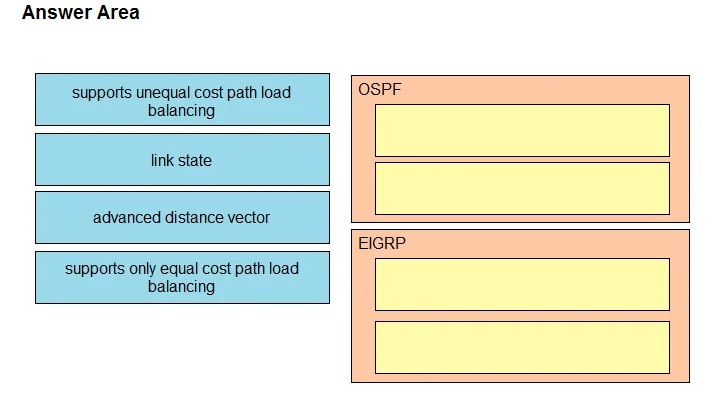
Drag and Drop Question Drag and drop the descriptions from the left onto the routing protocol they describe on the right. Answer:
The correct answer is link state; supports only equal cost path load balancing; advanced distance vector; supports unequal cost path load balancing. The correct arrangement matches OSPF with 'link state' and 'supports only equal cost path load balancing,' while EIGRP is matched with 'advanced distance vector' and 'supports unequal cost path load balancing.' OSPF is a pure link-state protocol that maintains a full topology…
Question
Drag and Drop Question Drag and drop the descriptions from the left onto the routing protocol they describe on the right. Answer:
Exhibit
Answer Area
Drag items
Correct arrangement
- link state
- supports only equal cost path load balancing
- advanced distance vector
- supports unequal cost path load balancing
Explanation
The correct arrangement matches OSPF with 'link state' and 'supports only equal cost path load balancing,' while EIGRP is matched with 'advanced distance vector' and 'supports unequal cost path load balancing.' OSPF is a pure link-state protocol that maintains a full topology map and performs equal-cost multi-path (ECMP) load balancing only. EIGRP is Cisco's hybrid 'advanced distance vector' (also called diffusing update algorithm-based) protocol that uniquely supports unequal-cost path load balancing using the 'variance' command.
Topics
Community Discussion
No community discussion yet for this question.