
350-401 · Question #815
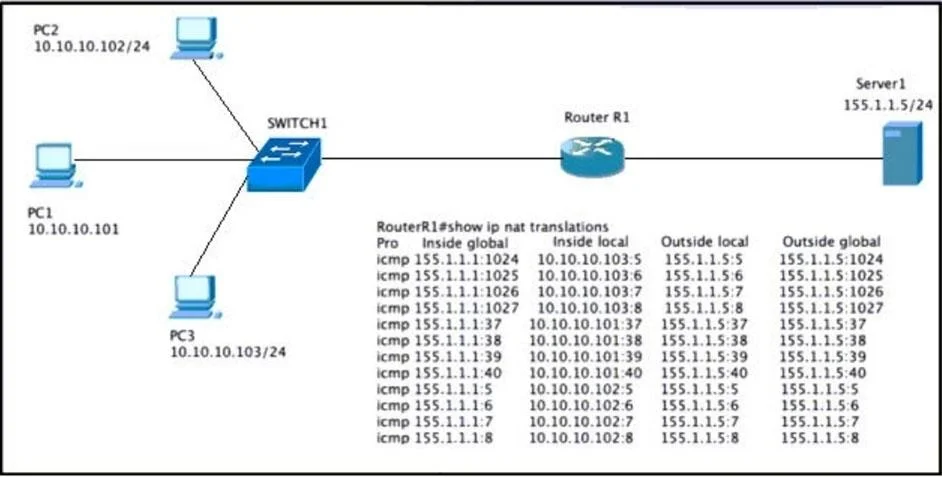
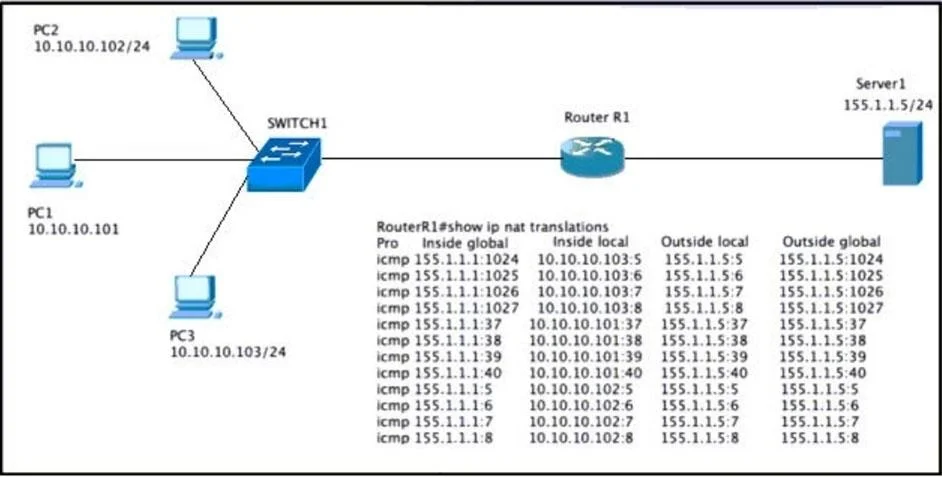
Refer to the exhibit. Hosts FC1, PC2; and PC3 must access resources on Server1. An engineer configures NAT on Router R1 to enable the communication and enters the show command to verify operation…
The correct answer is A. 155.1.1.1. When NAT Overload (PAT) is configured using an interface, all internal hosts appear to originate from the outside interface's IP address.
Question
Exhibits
Options
- A155.1.1.1
- Brandom addresses in the 155.1.1.0/24 range
- Ctheir own address in the 10.10.10.0/24 range
- D155.1.1.5
How the community answered
(43 responses)- A84% (36)
- B2% (1)
- C9% (4)
- D5% (2)
Why each option
When NAT Overload (PAT) is configured using an interface, all internal hosts appear to originate from the outside interface's IP address.
NAT Overload (Port Address Translation or PAT), configured with `ip nat inside source list <ACL> interface <OUTSIDE_INTERFACE> overload`, translates multiple inside local IP addresses to a single inside global IP address, which is the IP address of the router's outside interface.
Random addresses in the 155.1.1.0/24 range would imply a NAT pool is configured, but `interface overload` uses the interface's primary IP.
Their own addresses in the 10.10.10.0/24 range would be used if NAT was not functioning or not applied to these hosts, but the question states NAT is configured.
An IP address like 155.1.1.5 would be used if a specific NAT pool was configured with that address or a static NAT mapping, neither of which is implied by 'interface overload'.
Concept tested: NAT Overload (PAT) behavior
Source: https://www.cisco.com/c/en/us/td/docs/ios/security/config_nat/configuration/guide/nat_cfg_guide.html#wp1055745
Topics
Community Discussion
No community discussion yet for this question.