
350-401 · Question #793
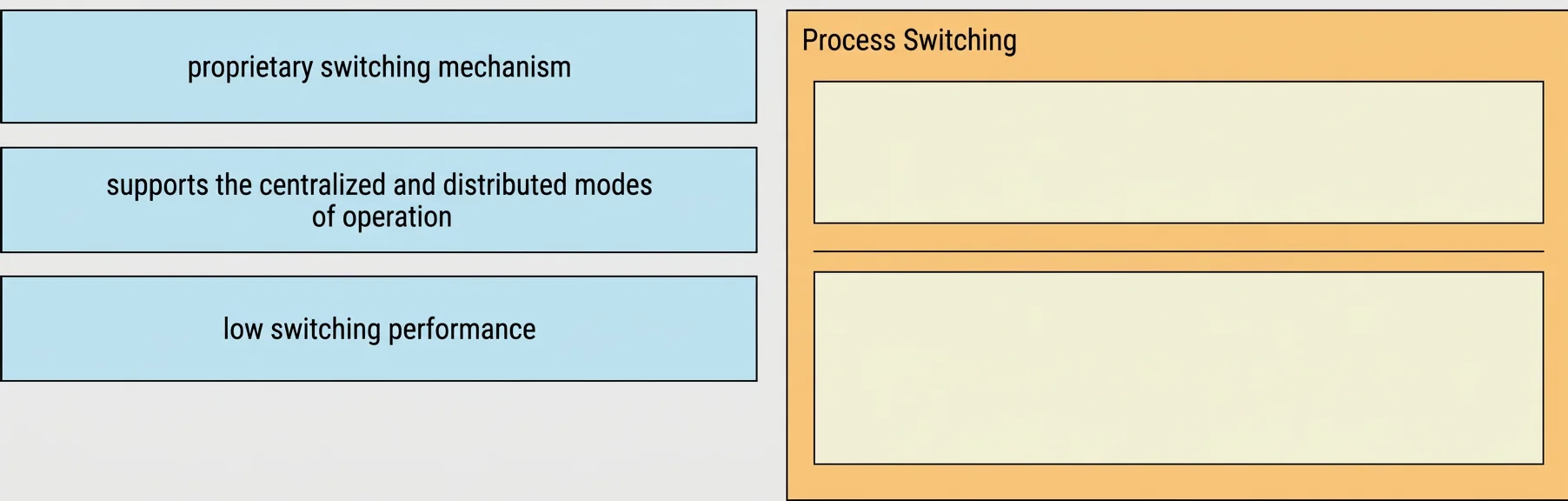
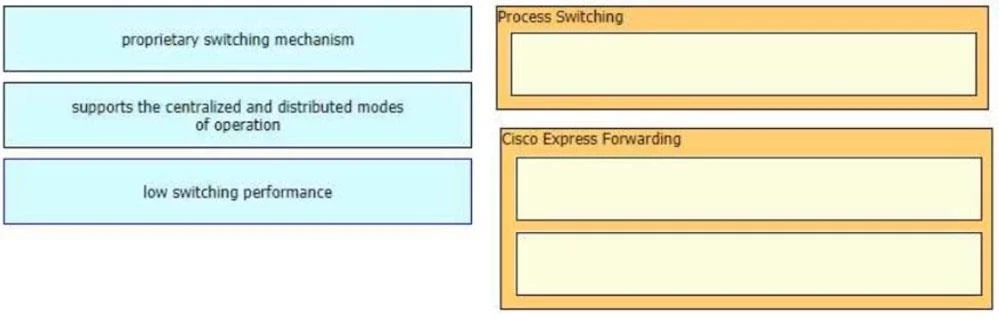
Drag and Drop Question Drag and drop the characteristics from the left onto the switching architectures on the right. Answer:
The correct answer is low switching performance; proprietary switching mechanism; supports the centralized and distributed modes of operation. The correct arrangement maps each characteristic to its corresponding switching architecture: 'low switching performance' applies to process switching (the oldest and slowest method, handled entirely by the CPU), 'proprietary switching mechanism' applies to fast switching…
Question
Drag and Drop Question Drag and drop the characteristics from the left onto the switching architectures on the right. Answer:
Exhibits
Answer Area
Drag items
Correct arrangement
- low switching performance
- proprietary switching mechanism
- supports the centralized and distributed modes of operation
Explanation
The correct arrangement maps each characteristic to its corresponding switching architecture: 'low switching performance' applies to process switching (the oldest and slowest method, handled entirely by the CPU), 'proprietary switching mechanism' applies to fast switching (Cisco's proprietary cache-based switching method that stores next-hop information in a fast-switching cache), and 'supports the centralized and distributed modes of operation' applies to Cisco Express Forwarding (CEF), which is the most advanced and scalable method, capable of operating in both centralized mode (route processor handles forwarding) and distributed mode (line cards handle forwarding independently). These three architectures represent the evolution of Cisco's packet-switching technologies, each with distinct performance and operational characteristics.
Topics
Community Discussion
No community discussion yet for this question.