
350-401 · Question #77
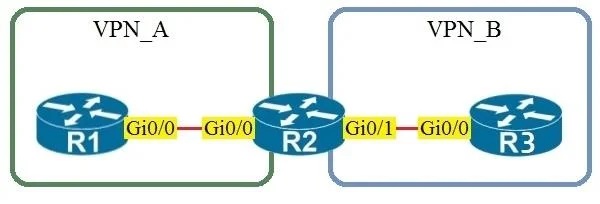
Refer to the exhibit. Assuming that R1 is a CE router, which VRF is assigned to Gi0/0 on R1?
The correct answer is B. Default VRF. Explanation Option B is correct because CE (Customer Edge) routers do not participate in MPLS VPN VRF configurations - that is the responsibility of the PE (Provider Edge) router. Since R1 is identified as a CE router, its Gi0/0 interface operates in the default (global)…
Question
Exhibits
Options
- AVRF VPN_B
- BDefault VRF
- CManagement VRF
- DVRF VPN_A
How the community answered
(24 responses)- A4% (1)
- B96% (23)
Explanation
Explanation
Option B is correct because CE (Customer Edge) routers do not participate in MPLS VPN VRF configurations - that is the responsibility of the PE (Provider Edge) router. Since R1 is identified as a CE router, its Gi0/0 interface operates in the default (global) routing table, not within any VRF instance.
Why the distractors are wrong:
- A (VRF VPN_B) and D (VRF VPN_A) are incorrect because VRFs are configured on PE routers to separate customer traffic within the provider's MPLS network - a CE router has no VRF awareness and simply treats its interfaces as standard routed interfaces.
- C (Management VRF) is incorrect because while management VRFs exist in some configurations, there is no indication of one here, and more importantly, CE routers still don't assign VRFs to their customer-facing interfaces in standard MPLS VPN architecture.
Memory Tip: Think of it this way - CE = Customer Equipment = Clueless about VRFs. The CE router simply sends and receives traffic normally; it's the PE router that does all the VRF "sorting." If a router is a CE, its interfaces live in the default routing table.
Topics
Community Discussion
No community discussion yet for this question.