
350-401 · Question #671
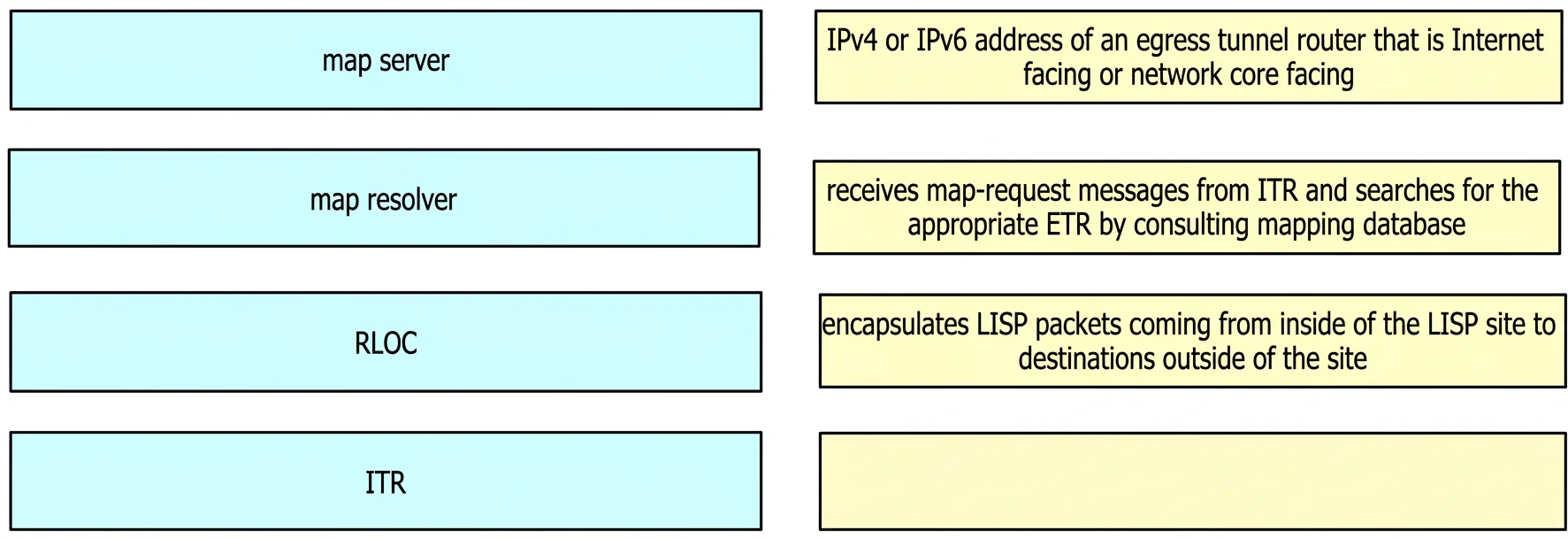
Drag and Drop Question Drag and drop the LISP components on the left to their descriptions on the right. Not all options are used. Answer:
The correct answer is RLOC; map resolver; map server; ITR. In LISP (Locator/ID Separation Protocol), the RLOC (Routing Locator) identifies the location of a device in the network topology (the router's address in the underlay), the Map Resolver receives Map-Requests from ITRs and forwards them to the Map Server, the Map Server learns…
Question
Drag and Drop Question Drag and drop the LISP components on the left to their descriptions on the right. Not all options are used. Answer:
Exhibit
Answer Area
Drag items
Correct arrangement
- RLOC
- map resolver
- map server
- ITR
Explanation
In LISP (Locator/ID Separation Protocol), the RLOC (Routing Locator) identifies the location of a device in the network topology (the router's address in the underlay), the Map Resolver receives Map-Requests from ITRs and forwards them to the Map Server, the Map Server learns EID-to-RLOC mappings from LISP site ETRs and answers mapping queries, and the ITR (Ingress Tunnel Router) receives packets from site endpoints, looks up EID-to-RLOC mappings, and encapsulates/forwards traffic into the LISP network. Each component plays a distinct and non-interchangeable role in the LISP control and data plane.
Topics
Community Discussion
No community discussion yet for this question.