
350-401 · Question #518
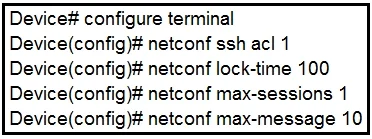
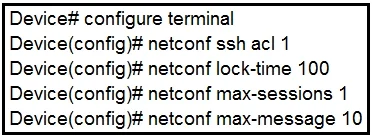
Refer to the exhibit. A network engineer must configure NETCONF. After creating the configuration, the engineer gets output from the command show line, but not from show running- config. Which…
The correct answer is D. Device(config)# netconf max-message 1000. NETCONF Configuration Explanation Option D (netconf max-message 1000) is correct because NETCONF has a default maximum message size limit, and when this limit is too small, larger outputs like show running-config are truncated or blocked entirely - while smaller outputs like…
Question
Exhibits
Options
- ADevice(config)# netconf max-sessions 100
- BDevice(config)# no netconf ssh acl 1
- CDevice(config)# netconf lock-time 500
- DDevice(config)# netconf max-message 1000
How the community answered
(51 responses)- A4% (2)
- B10% (5)
- C6% (3)
- D80% (41)
Explanation
NETCONF Configuration Explanation
Option D (netconf max-message 1000) is correct because NETCONF has a default maximum message size limit, and when this limit is too small, larger outputs like show running-config are truncated or blocked entirely - while smaller outputs like show line pass through successfully. Increasing the max-message size allows NETCONF to handle larger data payloads, resolving the issue.
Why the distractors are wrong:
- Option A (
max-sessions 100) controls how many concurrent NETCONF sessions are allowed, which is unrelated to message output size limitations. - Option B (
no netconf ssh acl 1) removes an access control list restriction, which would affect who can connect, not what data can be returned in a session. - Option C (
lock-time 500) configures how long a NETCONF lock persists on a datastore - a locking/concurrency feature, not a message size setting.
Memory Tip: Think of it this way - show running-config is a large file, so you need a large message limit. Associate "big config = big message size." If partial outputs work but large outputs fail, always suspect a message size constraint in NETCONF.
Topics
Community Discussion
No community discussion yet for this question.