
350-401 · Question #33
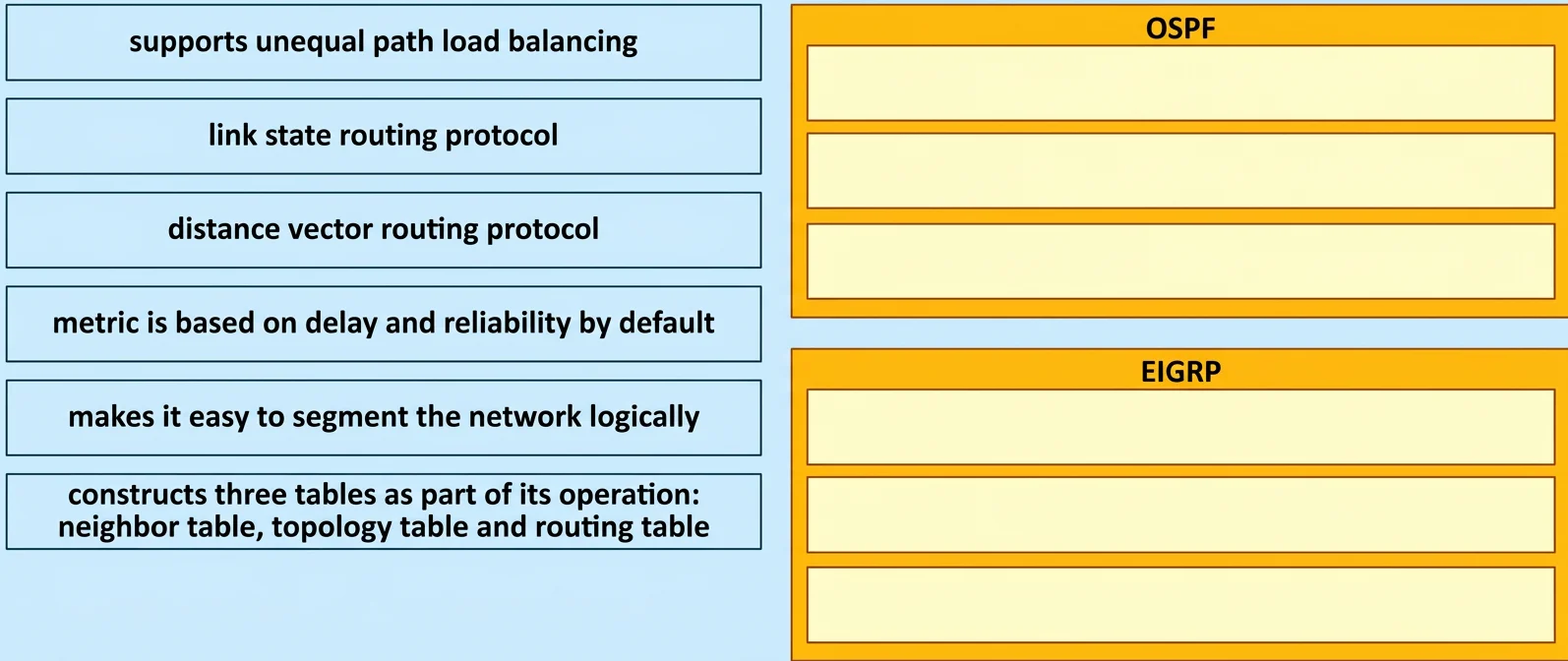
Drag and Drop Question Drag and drop the characteristics from the left onto the correct routing protocol types on the right. Answer:
The correct answer is OSPF: link state routing protocol; OSPF: makes it easy to segment the network logically; OSPF: constructs three tables as part of its operation: neighbor table, topology table and routing table; EIGRP: supports unequal path load balancing; EIGRP: distance vector routing protocol; EIGRP: metric is based on delay and reliability by default. OSPF is a link-state routing protocol that uses areas to logically segment the network (e.g., Area 0 backbone and subordinate areas), making network management scalable. OSPF constructs three distinct tables: a neighbor table (adjacency database), a topology table (link-state…
Question
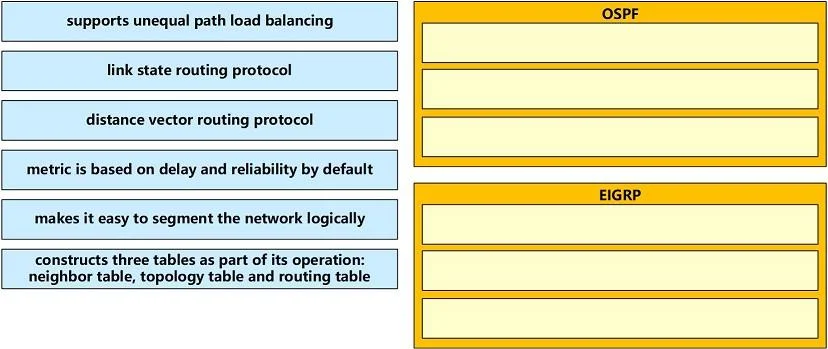
Drag and Drop Question Drag and drop the characteristics from the left onto the correct routing protocol types on the right. Answer:
Exhibits
Answer Area
Drag items
Correct arrangement
- OSPF: link state routing protocol
- OSPF: makes it easy to segment the network logically
- OSPF: constructs three tables as part of its operation: neighbor table, topology table and routing table
- EIGRP: supports unequal path load balancing
- EIGRP: distance vector routing protocol
- EIGRP: metric is based on delay and reliability by default
Explanation
OSPF is a link-state routing protocol that uses areas to logically segment the network (e.g., Area 0 backbone and subordinate areas), making network management scalable. OSPF constructs three distinct tables: a neighbor table (adjacency database), a topology table (link-state database), and a routing table (forwarding database). EIGRP, as an advanced distance-vector/hybrid protocol, supports unequal-cost path load balancing (via the variance command), uses a composite metric based on bandwidth, delay, reliability, and load (with delay and bandwidth as defaults - note: reliability is not a default metric component), and is classified as a distance-vector routing protocol.
Topics
Community Discussion
No community discussion yet for this question.