
350-401 · Question #317
Which tunneling technique is used when designing a Cisco SD-Access fabric data plane?
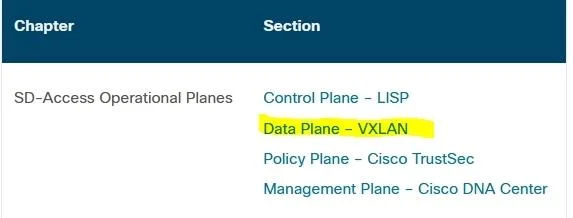
The correct answer is D. VXLAN. VXLAN in Cisco SD-Access Fabric VXLAN (Virtual Extensible LAN) is the tunneling protocol used for the data plane in Cisco SD-Access because it encapsulates Layer 2 frames within UDP packets, allowing traffic to be transported across the IP underlay network while preserving…
Question
Which tunneling technique is used when designing a Cisco SD-Access fabric data plane?
Exhibit
Options
- ALISP
- BVRF Lite
- CVRF
- DVXLAN
How the community answered
(36 responses)- B6% (2)
- C3% (1)
- D92% (33)
Explanation
VXLAN in Cisco SD-Access Fabric
VXLAN (Virtual Extensible LAN) is the tunneling protocol used for the data plane in Cisco SD-Access because it encapsulates Layer 2 frames within UDP packets, allowing traffic to be transported across the IP underlay network while preserving segmentation and enabling macro/micro-segmentation through scalable group tags (SGTs).
Why the distractors are wrong:
- LISP (A) is used for the control plane in SD-Access (handling endpoint registration and location/identity mapping), not the data plane - this is the most common trap in this question.
- VRF Lite (B) is a traditional WAN segmentation technique used outside of SD-Access fabric design and has no tunneling capability.
- VRF (C) is a logical network segmentation construct used within the SD-Access fabric for virtual networks, but it is not a tunneling protocol.
Memory Tip: Think "LISP Controls, VXLAN Carries" - LISP handles the control plane (where is the endpoint?), while VXLAN carries the actual data traffic through the fabric tunnel. If the question says data plane, always think VXLAN.
Topics
Community Discussion
No community discussion yet for this question.