
350-401 · Question #265
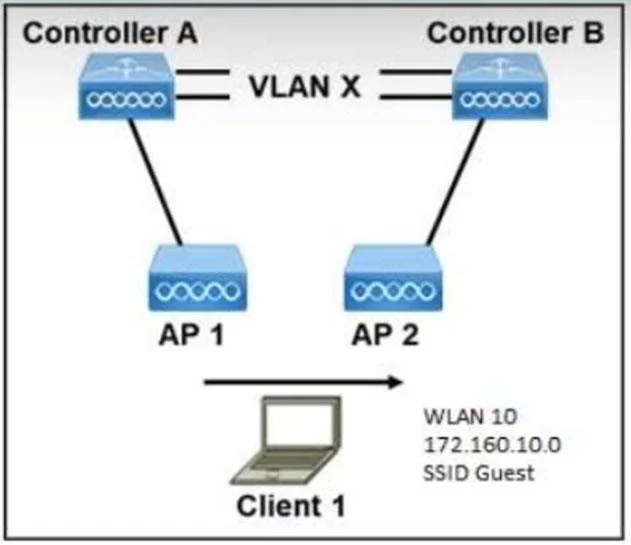
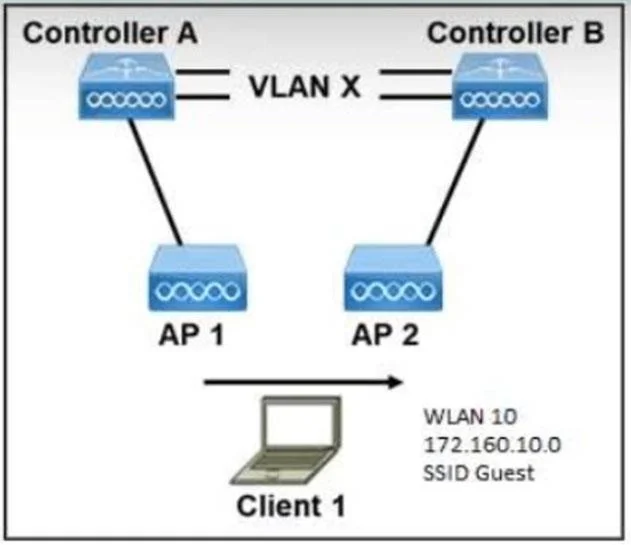
Refer to the exhibit. Both controllers are in the same mobility group. Which result occurs when client 1 roams between APs that are registered to different controllers in the same WLAN?
The correct answer is D. The client database entry moves from controller A to controller B. Why D is Correct: When a client roams between APs connected to different controllers within the same mobility group, the client's database entry is moved (not tunneled) from the anchor controller (Controller A) to the new foreign controller (Controller B). This is called an…
Question
Refer to the exhibit. Both controllers are in the same mobility group. Which result occurs when client 1 roams between APs that are registered to different controllers in the same WLAN?
Exhibits
Options
- AClient 1 contact controller B by using an EoIP tunnel.
- BCAPWAP tunnel is created between controller A and controller B.
- CClient 1 users an EoIP tunnel to contact controller A.
- DThe client database entry moves from controller A to controller B.
How the community answered
(39 responses)- A8% (3)
- B3% (1)
- C3% (1)
- D87% (34)
Explanation
Why D is Correct: When a client roams between APs connected to different controllers within the same mobility group, the client's database entry is moved (not tunneled) from the anchor controller (Controller A) to the new foreign controller (Controller B). This is called an inter-controller roam, and because both controllers are in the same mobility group and WLAN, the roam is seamless - the client gets a new IP from Controller B's subnet and the entry is fully transferred.
Why the Distractors Are Wrong:
- A & C are wrong because EoIP (Ethernet over IP) tunnels are used in Layer 3 roaming scenarios where the client retains its original IP address by tunneling traffic back to the anchor controller - this does NOT apply when the roam is within the same WLAN and mobility group performing a clean handoff.
- B is wrong because a CAPWAP tunnel exists between APs and their own controllers, not between two controllers during a roam event; inter-controller communication uses mobility messaging, not CAPWAP.
Memory Tip: Think of it this way - same mobility group = move the entry, different subnet/group = tunnel the traffic. If the controllers "know each other" well (same group, same WLAN), the client gets a fresh start on the new controller rather than maintaining a tunnel back to the old one.
Topics
Community Discussion
No community discussion yet for this question.