
350-401 · Question #243
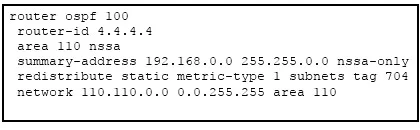
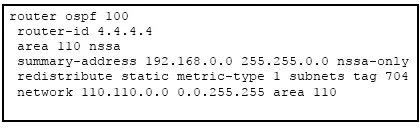
Refer to the exhibit. This is the configuration of the ASBR of area 110.Which option explains why the remote ABR should not translate the type 7 LSA for the prefix 192.168.0.0/16 into a type 5 LSA?
The correct answer is D. The ABR clears the P bit in the header of the type 7 LSA for 192.168.0.0/16. A remote ABR will not translate a Type 7 LSA into a Type 5 LSA if the ASBR originating the Type 7 LSA has cleared the P-bit (Propagate bit) in its header.
Question
Refer to the exhibit. This is the configuration of the ASBR of area 110.Which option explains why the remote ABR should not translate the type 7 LSA for the prefix 192.168.0.0/16 into a type 5 LSA?
Exhibits
Options
- AThe remote ABR translates all type 7 LSA into type 5 LSA, regardless of any option configured in
- BThe ASBR sets the forwarding address to 0.0.0.0 which instructs the ABR not to translate the
- CThe ASBR originates a type 7 LSA with age equal to MAXAGE 3600.
- DThe ABR clears the P bit in the header of the type 7 LSA for 192.168.0.0/16.
How the community answered
(53 responses)- A17% (9)
- B8% (4)
- C4% (2)
- D72% (38)
Why each option
A remote ABR will not translate a Type 7 LSA into a Type 5 LSA if the ASBR originating the Type 7 LSA has cleared the P-bit (Propagate bit) in its header.
This statement is incorrect; ABRs only translate Type 7 LSAs to Type 5 LSAs if the P-bit is set, not for all Type 7 LSAs.
Setting the forwarding address to 0.0.0.0 in a Type 7 LSA indicates that the ASBR itself is directly reachable for forwarding, but it does not control whether the ABR translates the LSA; the P-bit controls translation.
The LSA age field is used for LSA flooding and refresh, and an LSA with an age equal to MAXAGE (3600 seconds) indicates it should be flushed from the database, not that it prevents ABR translation.
The P-bit (Propagate bit) in a Type 7 LSA header is a flag set by the ASBR that indicates whether the LSA should be translated into a Type 5 LSA by the ABR; if the P-bit is cleared, the ABR will not perform the translation, preventing the route from being advertised outside the NSSA.
Concept tested: OSPF NSSA Type 7 LSA P-bit
Source: https://www.cisco.com/c/en/us/support/docs/ip/open-shortest-path-first-ospf/13689-18.html
Topics
Community Discussion
No community discussion yet for this question.