
350-401 · Question #227
What is the purpose of an RP in PIM?
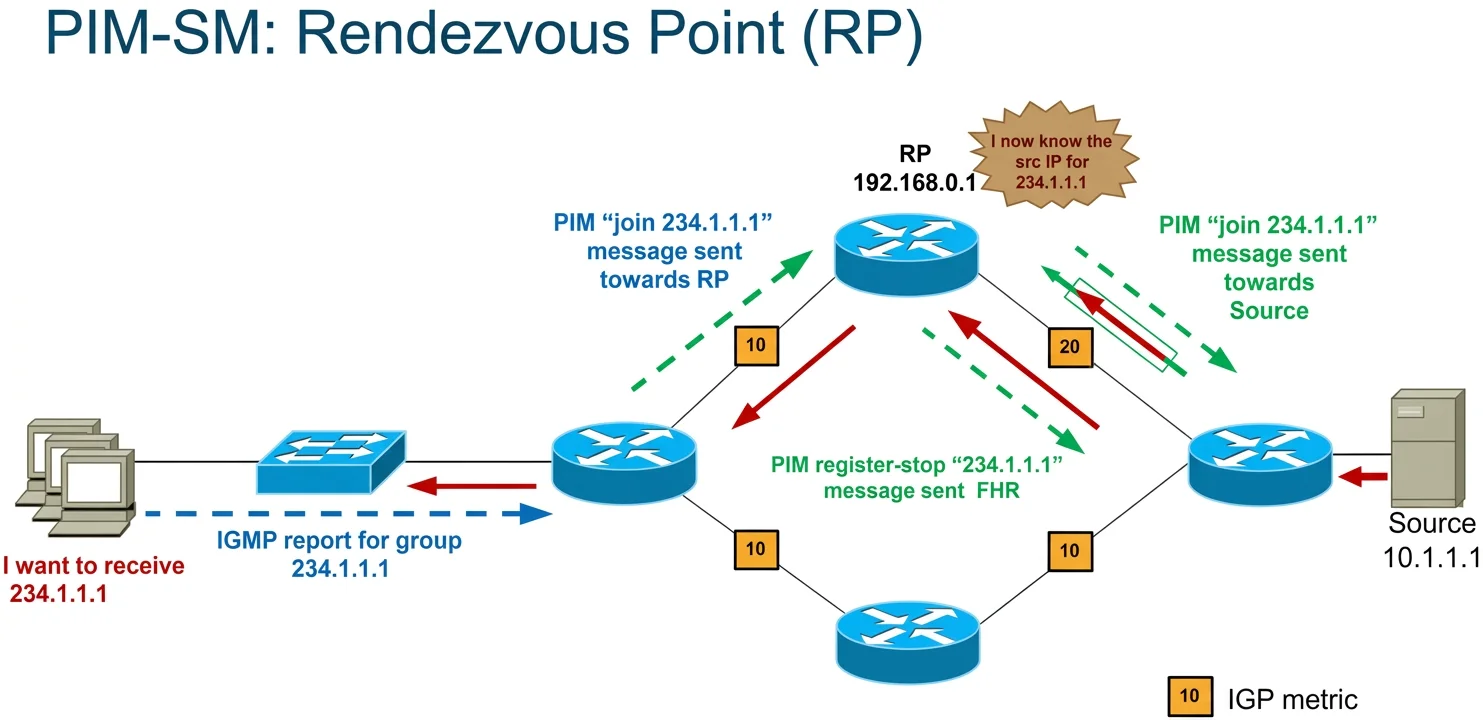
The correct answer is A. send join messages toward a multicast source SPT. PIM Rendezvous Point (RP) Explained In PIM Sparse Mode, the Rendezvous Point (RP) serves as a meeting place where multicast sources and receivers initially connect, and its core function is to send Join messages toward the source, building a Shared Distribution Tree (RPT) that…
Question
What is the purpose of an RP in PIM?
Exhibit
Options
- Asend join messages toward a multicast source SPT
- Bensure the shortest path from the multicast source to the receiver.
- Creceive IGMP joins from multicast receivers.
- Dsecure the communication channel between the multicast sender and receiver.
How the community answered
(41 responses)- A90% (37)
- B2% (1)
- C5% (2)
- D2% (1)
Explanation
PIM Rendezvous Point (RP) Explained
In PIM Sparse Mode, the Rendezvous Point (RP) serves as a meeting place where multicast sources and receivers initially connect, and its core function is to send Join messages toward the source, building a Shared Distribution Tree (RPT) that connects receivers to the multicast group - making Option A correct.
Why the distractors are wrong:
- Option B is incorrect because the RP actually creates a shared tree, not the shortest path; shortest-path trees (SPTs) are built after traffic switches away from the RP once a threshold is met.
- Option C is incorrect because IGMP joins are received by the designated router (DR) on the receiver's local segment, not the RP - the RP receives PIM Join messages, not IGMP messages.
- Option D is incorrect because the RP has no security function; it is purely a traffic distribution and tree-building mechanism.
Memory Tip: Think of the RP as a postal sorting hub - it doesn't secure or speed up delivery, it simply serves as the central point where mail (multicast traffic) is routed toward the source and distributed to receivers until a more direct route is established.
Topics
Community Discussion
No community discussion yet for this question.