
350-401 · Question #223
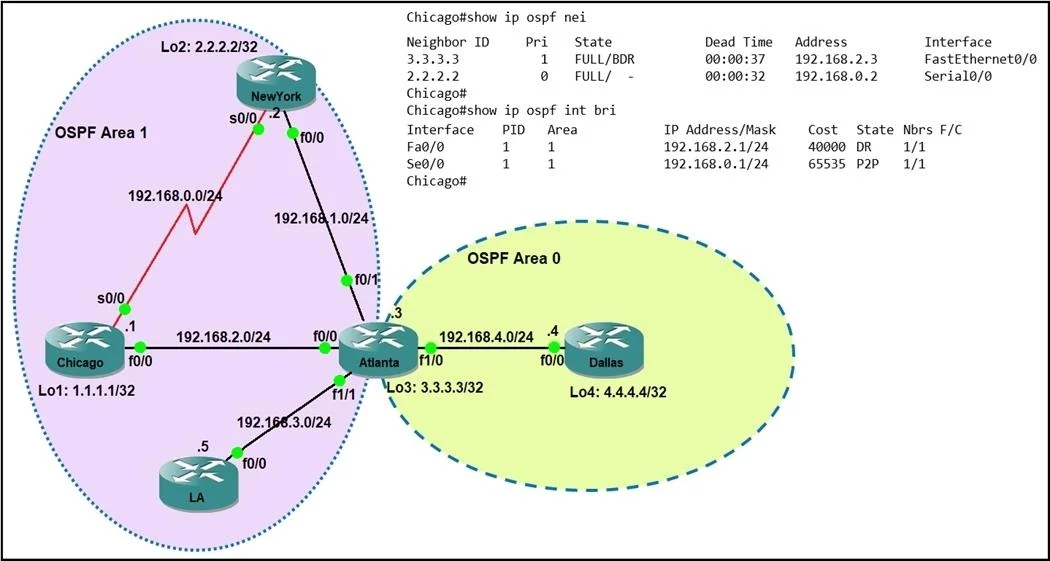
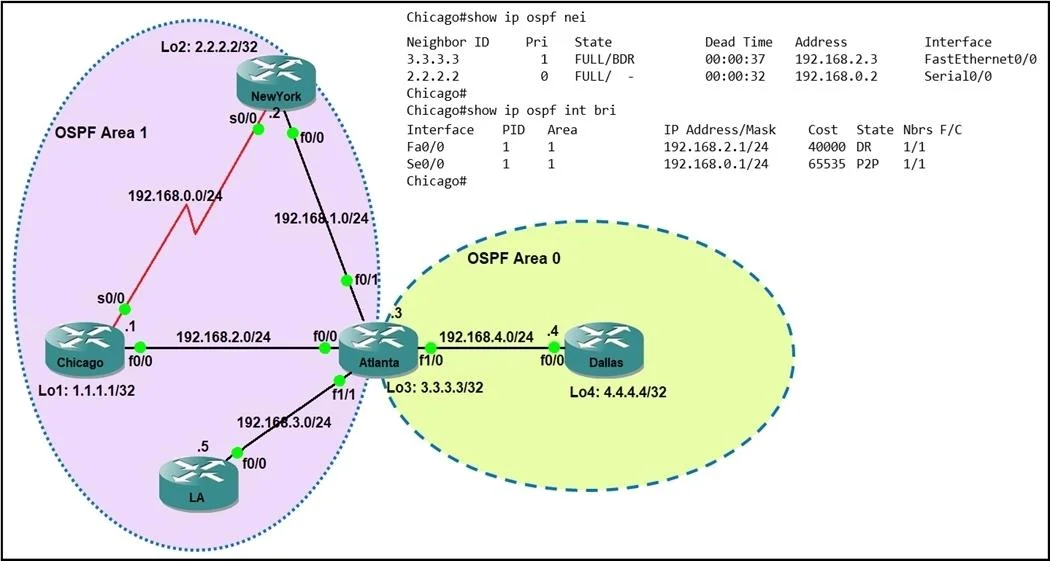
Refer the exhibit. Which router is the designated router on the segment 192.168.0.0/24?
The correct answer is B. This segment has no designated router because it is a p2p network type. OSPF Designated Router Explanation Option B is correct because point-to-point (p2p) network types in OSPF do not elect a Designated Router (DR) or Backup Designated Router (BDR) - DR/BDR elections only occur on broadcast and non-broadcast multi-access (NBMA) network types…
Question
Refer the exhibit. Which router is the designated router on the segment 192.168.0.0/24?
Exhibits
Options
- AThis segment has no designated router because it is a nonbroadcast network type.
- BThis segment has no designated router because it is a p2p network type.
- CRouter Chicago because it has a lower router ID
- DRouter NewYork because it has a higher router ID
How the community answered
(37 responses)- A3% (1)
- B89% (33)
- C3% (1)
- D5% (2)
Explanation
OSPF Designated Router Explanation
Option B is correct because point-to-point (p2p) network types in OSPF do not elect a Designated Router (DR) or Backup Designated Router (BDR) - DR/BDR elections only occur on broadcast and non-broadcast multi-access (NBMA) network types, where multiple routers share the same segment and need a central point to reduce LSA flooding overhead.
Why the distractors are wrong:
- Option A is incorrect because nonbroadcast (NBMA) networks do actually elect a DR/BDR, so the reasoning is flawed even if the conclusion about no DR seemed plausible.
- Option C is incorrect because lower router IDs lose DR elections (higher wins), and regardless, p2p links don't hold elections at all.
- Option D is incorrect because while a higher router ID does win DR elections on eligible network types, p2p segments bypass the election process entirely.
Memory Tip: Think "P2P = No Party (no DR/BDR)" - point-to-point links are a private conversation between two routers, so there's no need for a "meeting coordinator" (DR). Only networks with multiple neighbors (broadcast/NBMA) need to elect one.
Topics
Community Discussion
No community discussion yet for this question.