
350-401 · Question #208
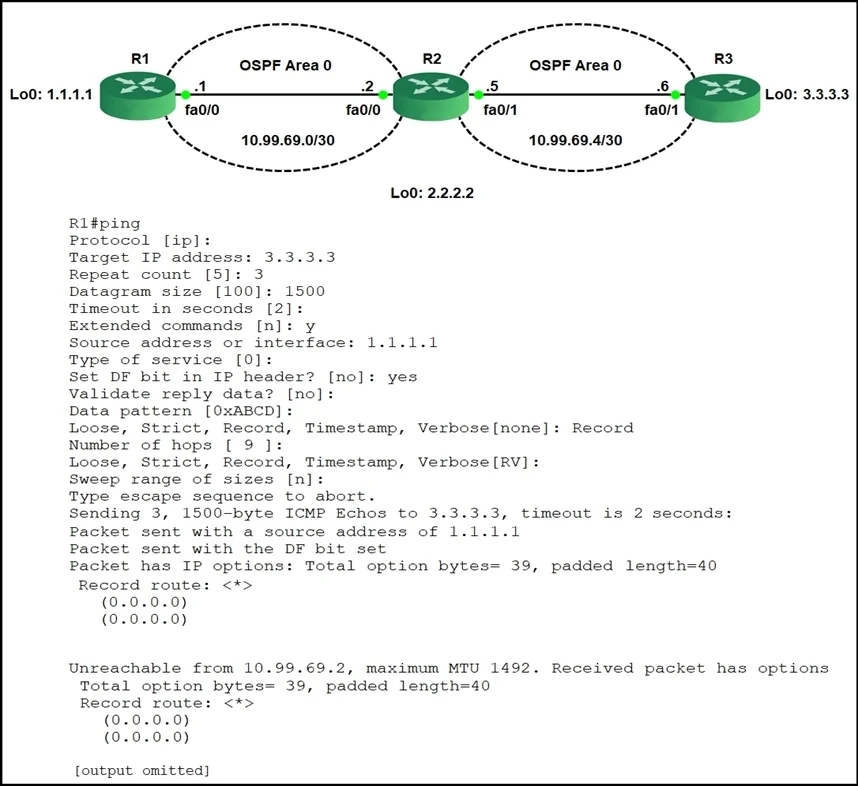
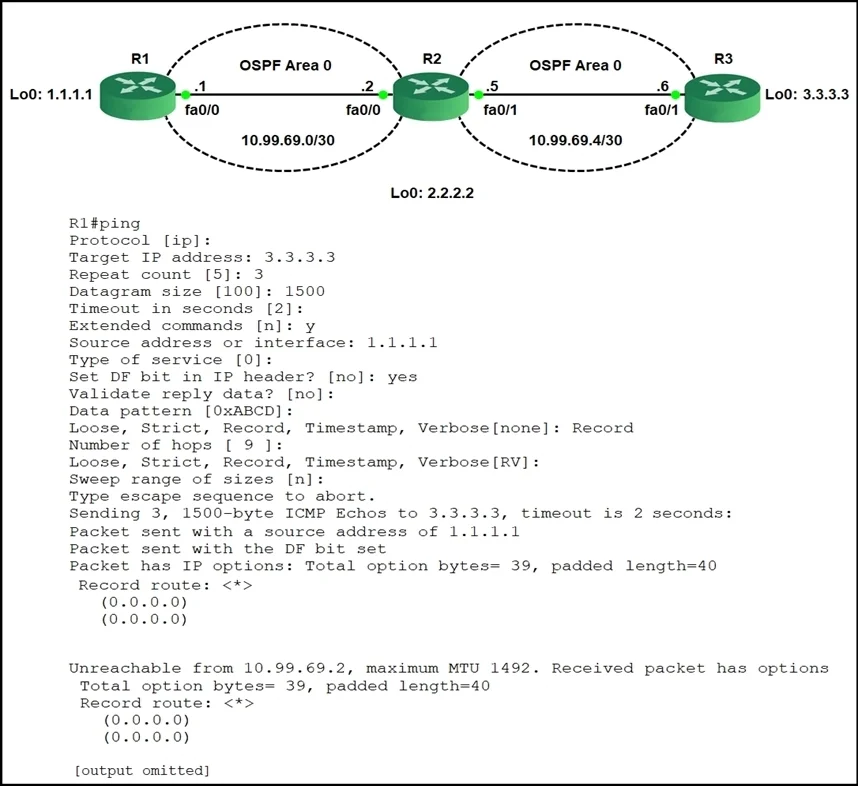
Refer to the exhibit. R1 is able to ping the R3 fa0/1 interface. Why do the extended pings fail?
The correct answer is D. The DF bit has been set. Explanation Setting the DF (Don't Fragment) bit in an extended ping tells routers along the path that the packet cannot be fragmented. When a packet exceeds the MTU of a link and the DF bit is set, the intermediate router must drop the packet and send an ICMP "Fragmentation…
Question
Refer to the exhibit. R1 is able to ping the R3 fa0/1 interface. Why do the extended pings fail?
Exhibits
Options
- AThe maximum packet size accepted by the command is 1476 bytes.
- BR3 is missing a return route to 10.99.69.0/30
- CR2 and R3 do not have an OSPF adjacency
- DThe DF bit has been set
How the community answered
(34 responses)- A3% (1)
- B6% (2)
- C9% (3)
- D82% (28)
Explanation
Explanation
Setting the DF (Don't Fragment) bit in an extended ping tells routers along the path that the packet cannot be fragmented. When a packet exceeds the MTU of a link and the DF bit is set, the intermediate router must drop the packet and send an ICMP "Fragmentation Needed" message back to the source - this is why the larger packet sizes (1500 bytes) fail while a standard ping succeeds with smaller packets. Option B is incorrect because R1 can already ping R3's fa0/1, confirming a return route exists. Option C is wrong for the same reason - an existing successful ping proves OSPF adjacency and routing are functioning. Option A is incorrect because 1500 bytes is a standard, supported packet size; the issue is not a command limitation but rather the MTU ceiling combined with the DF bit preventing fragmentation.
Memory Tip: Think of the DF bit as a "Do Not Bend" sticker on a package - if it won't fit through a slot, the postal worker can't fold it and must return it. If pings work at small sizes but fail at larger sizes, always suspect MTU + DF bit before assuming routing problems.
Topics
Community Discussion
No community discussion yet for this question.