
350-401 · Question #193
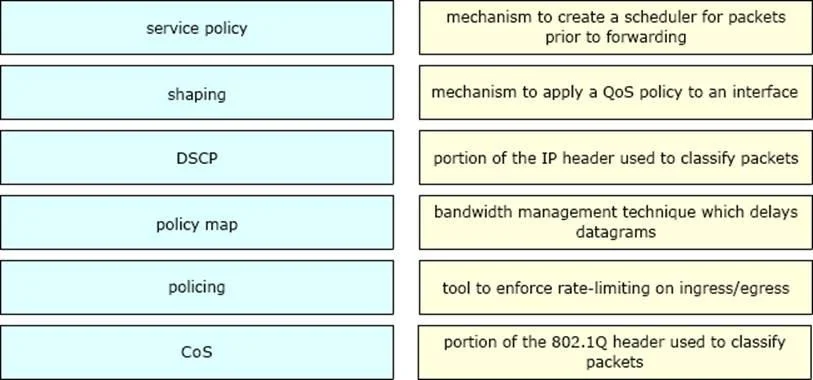
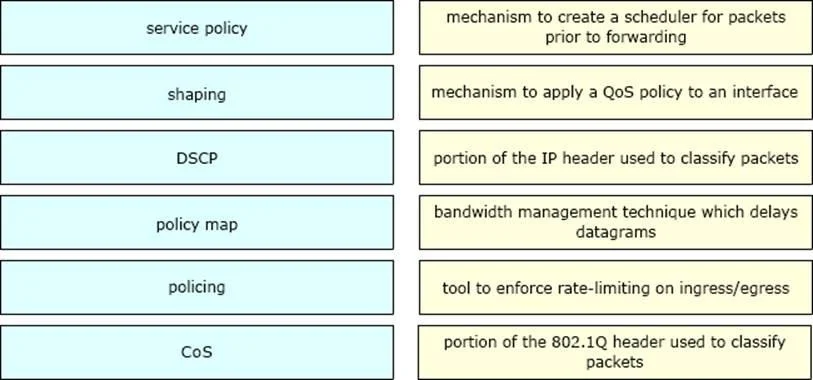
Drag and Drop Question Drag and drop the Qos mechanisms from the left to the correct descriptions on the right. Answer:
QoS Mechanisms - Explained --- 1. CoS -> portion of the 802.1Q header used to classify packets Class of Service (CoS) operates at Layer 2. The 802.1Q VLAN tag contains a 3-bit Priority Code Point (PCP) field (also called CoS), providing 8 priority levels (0-7). Because it lives…
Question
Exhibits
Explanation
QoS Mechanisms - Explained
1. CoS -> portion of the 802.1Q header used to classify packets
Class of Service (CoS) operates at Layer 2. The 802.1Q VLAN tag contains a 3-bit Priority Code Point (PCP) field (also called CoS), providing 8 priority levels (0-7). Because it lives in the Ethernet frame header, it only works on switched/VLAN-tagged traffic - it disappears when a packet crosses a Layer 3 boundary.
2. DSCP -> portion of the IP header used to classify packets
Differentiated Services Code Point (DSCP) operates at Layer 3. It uses the 6 most significant bits of the ToS (Type of Service) byte in the IP header, providing 64 possible values. Because it's in the IP header, it survives Layer 3 routing - making it the preferred marking mechanism end-to-end across routed networks.
Common mistake: Confusing DSCP with IP Precedence. IP Precedence uses only the first 3 bits of the same ToS byte; DSCP is its modern, more granular replacement and is backward-compatible.
3. Shaping -> bandwidth management technique which delays datagrams
Traffic shaping buffers excess traffic and smooths the output rate by introducing delay. Packets exceeding the configured rate are held in a queue and sent later rather than dropped. This produces a smooth, conforming traffic profile at the cost of added latency.
Common mistake: Thinking shaping is lossless - queues can still overflow and drop packets if sustained traffic far exceeds the shape rate.
4. Policing -> tool to enforce rate-limiting on ingress/egress
Traffic policing measures the traffic rate against a configured limit and immediately drops or re-marks non-conforming packets - no buffering, no delay. It's applied at both ingress and egress and is the standard tool ISPs use to enforce customer SLAs.
Common mistake: Confusing policing with shaping. The key distinction: policing drops or re-marks; shaping delays. Policing has no queue for excess traffic.
5 & 6 - Note: These two descriptions appear swapped in the question
In standard Cisco MQC (Modular QoS CLI) terminology:
| Term | Actual Role |
|---|---|
| policy-map | Defines QoS actions (scheduling, policing, marking) - i.e., creates the scheduler |
| service-policy | Applies the policy-map to an interface - i.e., activates the QoS policy |
The question maps them as:
- policy map -> applies a QoS policy to an interface
- service policy -> creates a scheduler for packets prior to forwarding
This is reversed from standard Cisco IOS behavior. If this is a Cisco exam question, flag it - the conventional understanding is:
policy-map= the scheduler definition (what to do with traffic classes)service-policy= the interface attachment command (where to apply the policy-map)
Common mistake: Exactly what this question demonstrates - confusing which command creates the policy vs. which applies it. Remember: you define with
policy-map, you deploy withservice-policy.
Topics
Community Discussion
No community discussion yet for this question.