
350-401 · Question #183
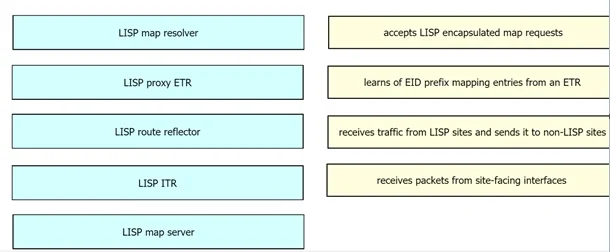
Drag and Drop Question Drag and drop the LISP components from the left onto the function they perform on the right. Not all options are used. Answer:
The correct answer is LISP map resolver; LISP proxy ETR; LISP route reflector; LISP ITR; LISP map server. In LISP (Locator/ID Separation Protocol), each component has a distinct role: the Map Resolver receives Map-Request messages from ITRs and queries the mapping system; the Proxy ETR (PETR) handles traffic on behalf of LISP sites toward non-LISP destinations; the Route Reflector…
Question
Drag and Drop Question Drag and drop the LISP components from the left onto the function they perform on the right. Not all options are used. Answer:
Exhibit
Answer Area
Drag items
Correct arrangement
- LISP map resolver
- LISP proxy ETR
- LISP route reflector
- LISP ITR
- LISP map server
Explanation
In LISP (Locator/ID Separation Protocol), each component has a distinct role: the Map Resolver receives Map-Request messages from ITRs and queries the mapping system; the Proxy ETR (PETR) handles traffic on behalf of LISP sites toward non-LISP destinations; the Route Reflector distributes LISP mapping information within a BGP-like control plane; the ITR (Ingress Tunnel Router) encapsulates packets from non-LISP to LISP sites by resolving EID-to-RLOC mappings; and the Map Server registers EID prefixes from ETRs and makes them available to the mapping system. All five options listed are used in this arrangement, each matching its core function in the LISP architecture.
Topics
Community Discussion
No community discussion yet for this question.